

Which Layer Is The Coolest
Key Findings
California voters have now received their mail ballots, and the Nov eight general election has entered its final phase. Amid rising prices and economic uncertainty—also equally deep partisan divisions over social and political issues—Californians are processing a neat bargain of information to assistance them choose land ramble officers and country legislators and to brand policy decisions about country propositions. The 2022 midterm ballot also features a closely divided Congress, with the likelihood that a few races in California may decide which political party controls the U.s.a. House.
These are among the key findings of a statewide survey on land and national issues conducted from October xiv to 23 by the Public Policy Constitute of California:
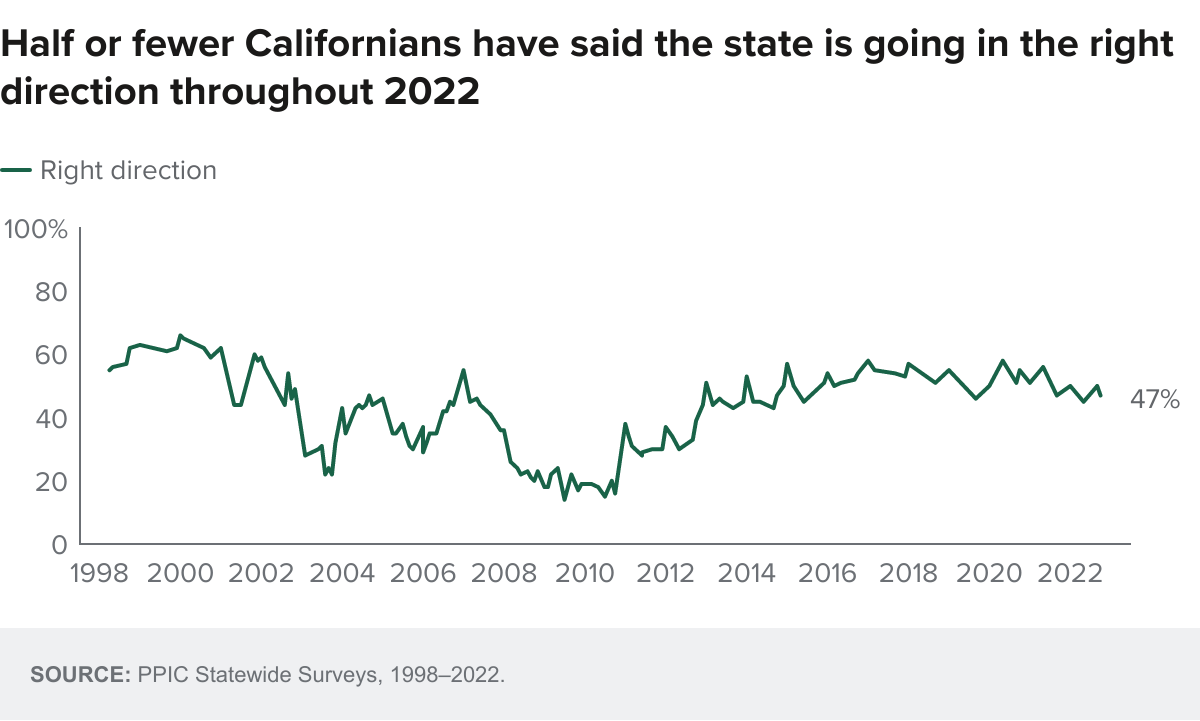
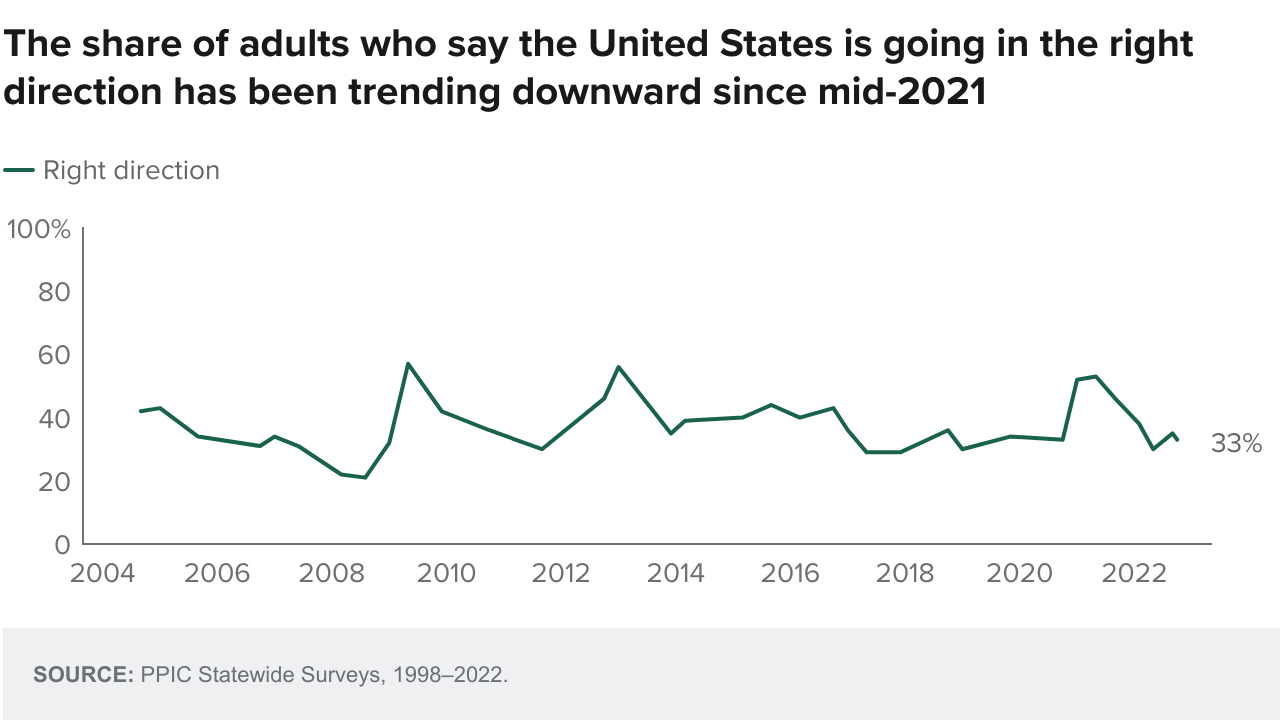
- Many Californians have negative perceptions of their personal finances and the US economy. Seventy-six per centum charge per unit the nation's economy as "non so skilful" or "poor." Thirty-nine per centum say their finances are "worse off" today than a year ago. Forty-seven percentage say that things in California are going in the right direction, while 33 percent call up things in the US are going in the correct direction; partisans differ in their overall outlook.→
-
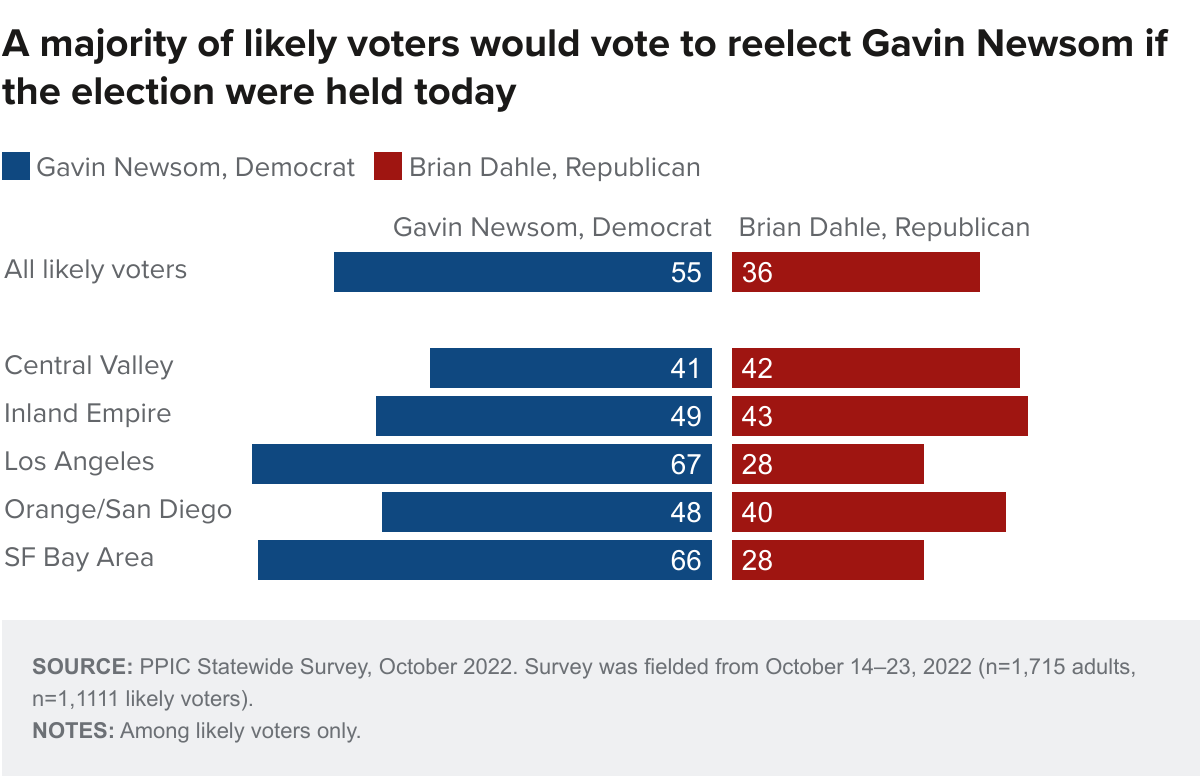
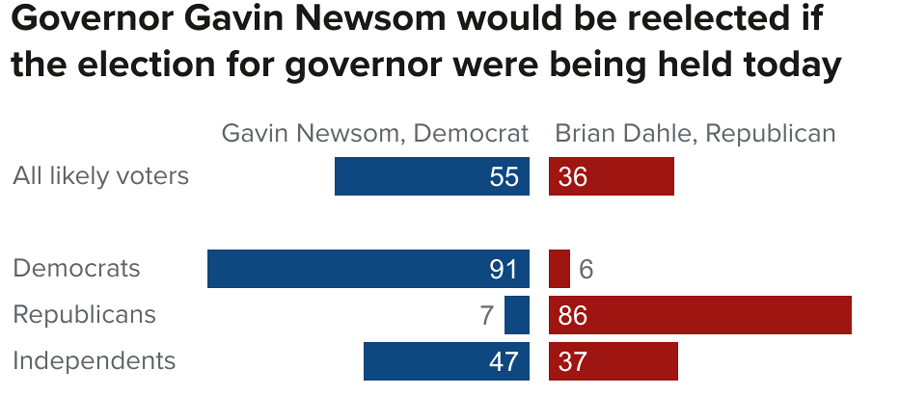 Among likely voters, 55 percent would vote for Gavin Newsom and 36 percent would vote for Brian Dahle if the governor'due south election were today. Partisans are deeply divided in their choices. Threescore pct are very or fairly closely following news near the governor's race. Sixty-two percent are satisfied with the candidate choices in the governor'due south ballot.→
 -
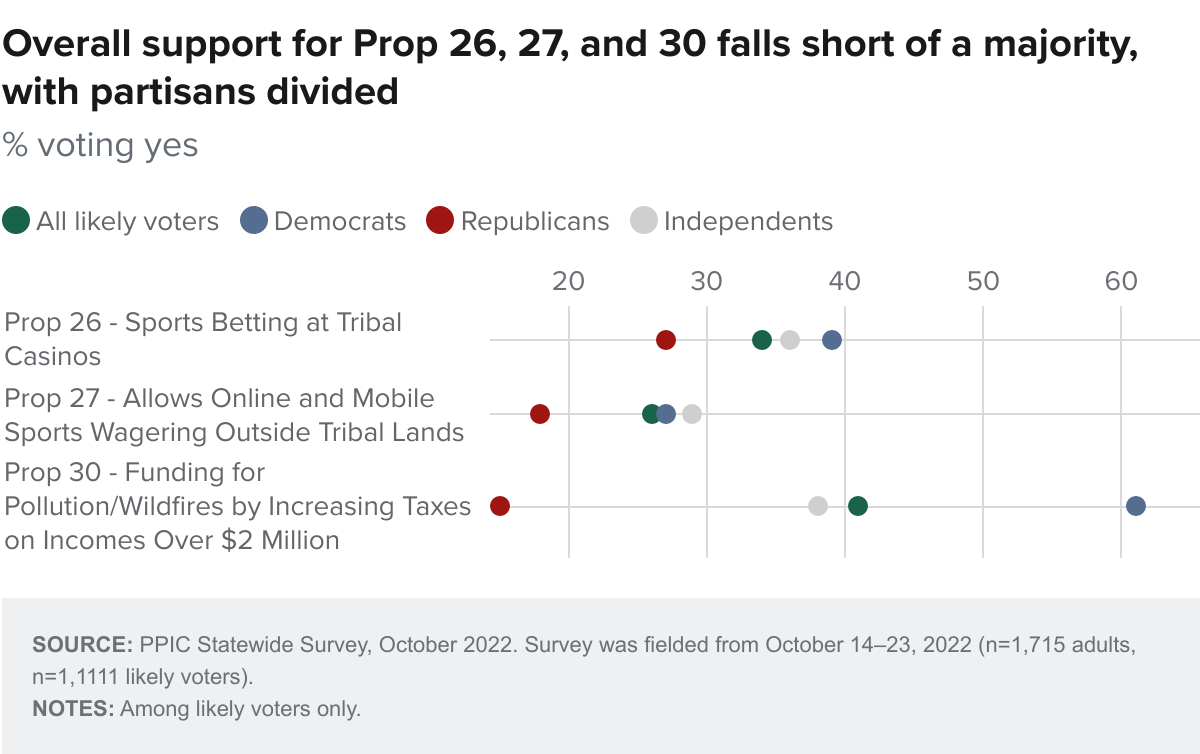
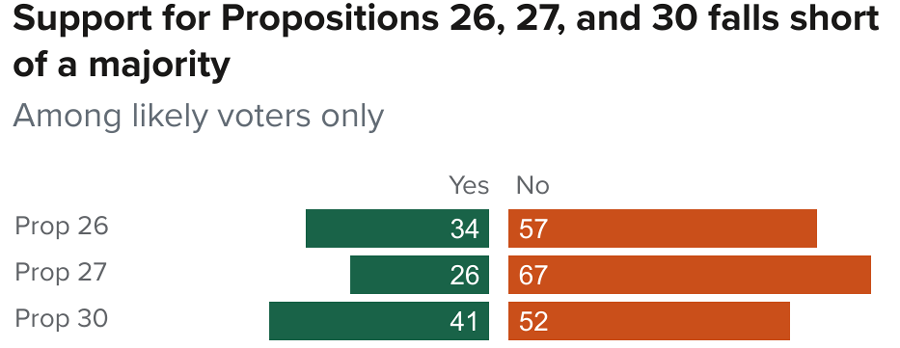 When likely voters are read the ballot title and labels, 34 percent would vote yes on Proposition 26 (sports betting at tribal casinos), 26 percent would vote yes on Proffer 27 (online sports gambling), and 41 pct would vote yes on Proposition xxx (reducing greenhouse gases). Most likely voters say they are non personally interested in sports betting, and 48 per centum recall it would be a "bad thing" if information technology became legal in the land. Fewer than half of likely voters say the vote effect of Propositions 26, 27, or 30 is very important to them.→
 -
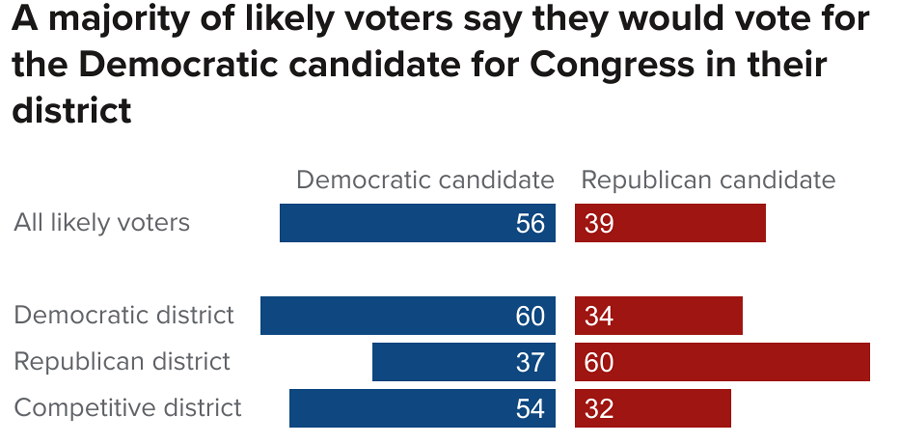 L-half dozen percent of likely voters would support the Democratic candidate in their US Business firm race if the election were today. Sixty-one percentage say the issue of abortion rights is very important in their vote for Congress this yr; Democrats are far more likely than Republicans or independents to concur this view. Virtually half are "extremely" or "very" enthusiastic about voting for Congress this year; 54 percent of Republicans and Democrats, and 41 per centum of independents, are highly enthusiastic this year.→
 - Forty-five pct of Californians and 40 percent of likely voters are satisfied with the fashion that republic is working in the United states of america. Republicans are far less likely than Democrats and independents to concord this positive view. There is rare partisan consensus on ane topic: majorities of Democrats, Republicans, and independents are pessimistic that Americans with different political views can notwithstanding come up together and piece of work out their differences.→
- Majorities of California adults and probable voters approve of Governor Gavin Newsom and President Joe Biden. About 4 in ten or more than California adults and likely voters approve of US Senator Dianne Feinstein and U.s. Senator Alex Padilla. These approval ratings vary beyond partisan groups. Blessing of the state legislature is higher than approval of the US Congress.→
Overall Mood
With less than two weeks to go until what is set to be a highly consequential midterm election, California adults are divided on whether the state is generally headed in the right direction (47%) or incorrect direction (48%); a majority of probable voters (54%) think the land is headed in the wrong direction (43% right management). Similar shares held this view final calendar month (wrong direction: 44% adults, 49% likely voters; right management: fifty% adults, 48% likely voters). Today, in that location is a wide partisan divide: seven in 10 Democrats are optimistic nearly the direction of the state, while 91 percent of Republicans and 59 percent of independents are pessimistic. Majorities of residents in the Central Valley and Orange/San Diego say the land is going in the incorrect management, while a majority in the San Francisco Bay Area say right direction; adults elsewhere are divided. Beyond demographic groups, Californians ages 18 to 34 (threescore%), Asian Americans (52%), higher graduates (52%), renters (52%), and women (52%) are the only groups in which a bulk are optimistic virtually California's direction.
Californians are much more pessimistic about the direction of the state than they are about the direction of the country. Solid majorities of adults (62%) and likely voters (71%) say the United States is going in the wrong management, and majorities have held this view since September 2021. One in three or fewer adults (33%) and likely voters (25%) think the country is going in the right direction. Majorities across all demographic groups and partisan groups, as well as across regions, are pessimistic virtually the direction of the United States.
The country of the economy and inflation are likely to play a critical role in the upcoming ballot, and most four in ten adults (39%) and likely voters (43%) say they and their family are worse off financially than they were a year ago. Similar shares say they are financially in about the same spot (43% adults, 44% likely voters). The share who feel they are worse off has risen slightly among likely voters since May, just is similar among adults (37% adults, 36% likely voters). Fewer than two in 10 Californians say they are better off than they were i year ago (17% adults, xiii% likely voters). A wide partisan divide exists: most Democrats and independents say their financial situation is about the same every bit a year agone, while solid majorities of Republicans say they are worse off. Regionally, about half in the San Francisco Bay Area and Los Angeles say they are virtually the aforementioned, while one-half in the Central Valley say they are worse off; residents elsewhere are divided between existence worse off and the same. Across demographic groups, pluralities say they are either financially near the aforementioned as final year or worse off, with the exception of African Americans (51% about the same, 33% worse off, 16% better off) and Asian Americans (51% about the same, 27% worse off, xx% better off). The shares maxim they are worse off decline as educational attainment increases.
With persistent inflation and concerns about a possible recession in the future, an overwhelming majority of Californians believe the The states economy is in non and so skillful (43% adults, twoscore% likely voters) or poor (33% adults, 36% likely voters) shape. About a quarter of adults (iii% excellent, xx% good) and likely voters (2% fantabulous, 23% good) feel positively well-nigh the national economy. Strong majorities beyond partisan groups experience negatively, just Republicans and independents are much more than likely than Democrats to say the economy is in poor shape. Solid majorities beyond the land'southward major regions also equally all demographic groups say the economy is in not so good or poor shape. In a recent ABC News/Washington Post poll, 24 percent (iii% splendid, 21% good) of adults nationwide felt positively about the US economy, while 74 percent (36% non so expert, 38% poor) expressed negative views.
Gubernatorial Election
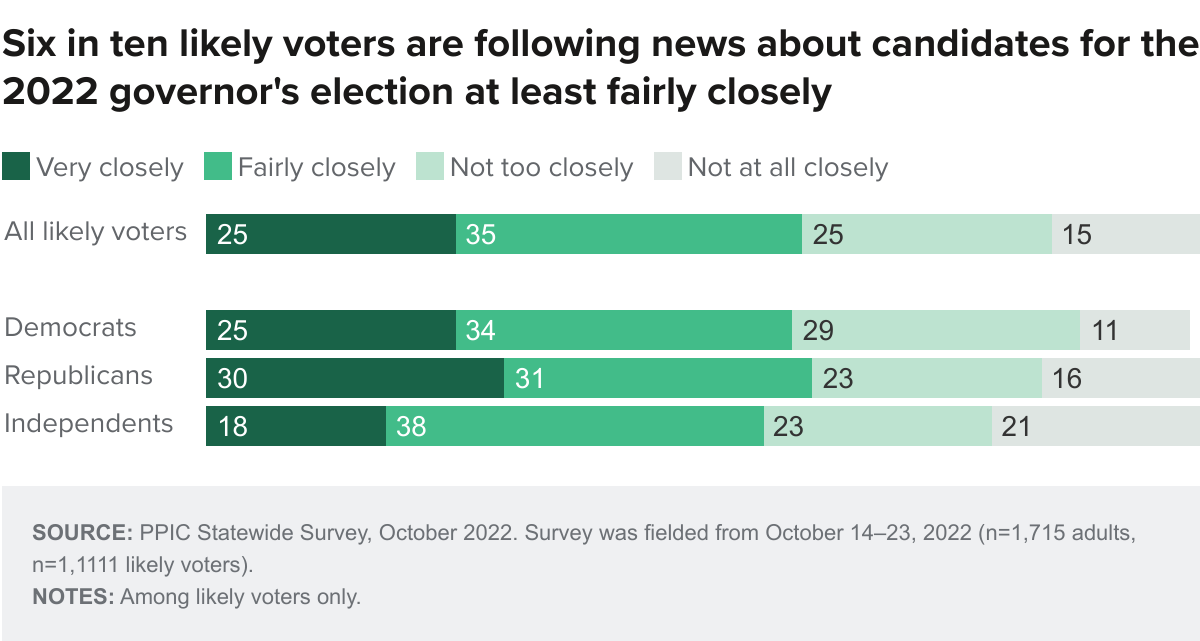
6 in ten likely voters say they are following news about the 2022 governor's race very (25%) or fairly (35%) closely—a share that has risen from half just a month ago (17% very, 33% fairly). This finding is somewhat similar to October 2018, when 68 per centum said this (28% very, twoscore% closely) a calendar month earlier the previous gubernatorial election. Today, majorities beyond partisan, demographic, and regional groups say they are following news nigh the gubernatorial election either very or fairly closely. The shares saying they are following the news very closely is highest amongst residents in Republican districts (39%), Republicans (30%), whites (29%), and adults with incomes of $40,000 to $79,999 (29%). Older probable voters (27%) are slightly more than probable than younger likely voters (21%) to say they are post-obit the news closely.
Democratic incumbent Gavin Newsom is ahead of Republican Brian Dahle (55% to 36%) among likely voters, while few say they would not vote, would vote for neither, or don't know who they would vote for in the governor'due south race. The share supporting the reelection of the governor was like a month ago (58% Newsom, 31% Dahle). Today, Newsom enjoys the support of well-nigh Democrats (91%), while most Republicans (86%) back up Dahle; Newsom has an edge over Dahle among independent likely voters (47% Newsom, 37% Dahle). Across the state'southward regions, ii in three in the San Francisco Bay Area and Los Angeles back up Newsom, equally practice nearly half in the Inland Empire and Orange/San Diego; likely voters in the Fundamental Valley are separate. Newsom leads in all demographic groups, with the exception of men (45% Newsom, 44% Dahle) and those with a high schoolhouse diploma only (46% Newsom, 49% Dahle). The share supporting Newsom grows every bit educational attainment increases (46% loftier school only, 56% some higher, threescore% college graduates), while it decreases with ascension income (64% less than $twoscore,000, 56% $40,000 to $79,999, 52% $80,000 or more than).
A solid majority of probable voters (62%) are satisfied with their choices of candidates in the November 8 election, while nigh three in ten (32%) are not satisfied. Shares expressing satisfaction accept increased somewhat from a month agone (53%) and were similar prior to the 2018 gubernatorial ballot (lx% Oct 2018). Today, a solid majority of Democrats (79%) and independents (61%) say they are satisfied, compared to fewer than one-half of Republicans (44%). Majorities across demographic groups say they are satisfied, and notably, women (68%) are more likely than men (56%) to say this. Majorities beyond the state's regions say they are satisfied with their choices of candidates in the upcoming gubernatorial ballot.
Country Propositions 26, 27, and 30
In the upcoming November 8 election, there will be seven state propositions for voters. Due to time constraints, our survey only asked about iii ballot measures: Propositions 26, 27, and 30. For each, we read the proposition number, ballot, and ballot label. 2 of the country ballot measures were also included in the September survey (Propositions 27 and 30), while Suggestion 26 was not.
If the election were held today, 34 pct of likely voters would vote "yes," 57 percent would vote "no," and 9 percent are unsure of how they would vote on Proposition 26—Allows In-Person Roulette, Dice, Game, Sports Wagering on Tribal Lands. This mensurate would allow in-person sports betting at racetracks and tribal casinos, requiring that racetracks and casinos offer sports betting brand certain payments to the state to support state regulatory costs. It also allows roulette and dice games at tribal casinos and adds a new way to enforce certain land gambling laws. In that location is partisan agreement on Prop 26: fewer than four in x Democrats, Republicans, and independents would vote "yes." Moreover, less than a majority across all regions and demographic groups—with the exception of likely voters ages 18 to 44 (51% yes, 44% no)—would vote "yes."
If the election were held today, 26 percent of likely voters would vote "yeah," 67 percent would vote "no," and viii percent are unsure of how they would vote on Suggestion 27—Allows Online and Mobile Sports Wagering Outside Tribal Lands. This citizens' initiative would allow Indian tribes and affiliated businesses to operate online and mobile sports wagering outside tribal lands. Strong majorities across partisan groups would vote "no" on Prop 27. The share voting "yes" has decreased since a month ago (34% September). Today, fewer than three in 10 across partisan groups would vote "yes" on Prop 27. Moreover, fewer than 4 in ten across regions, gender, racial/ethnic, didactics, and income groups would vote "yes." Probable voters ages xviii to 44 (41%) are far more likely than older probable voters ages 45 and in a higher place (19%) to say they would vote "yes."
If the ballot were held today, 41 percent of likely voters would vote "yep," 52 percent would vote "no," and 7 percent are unsure of how they would vote on Proposition thirty—Provides Funding for Programs to Reduce Air Pollution and Forestall Wildfires by Increasing Revenue enhancement on Personal Income over $2 Million. This citizens' initiative would increase taxes on Californians earning more than $ii million annually and allocate that tax revenue to zero-emission vehicle purchase incentives, vehicle charging stations, and wildfire prevention. The share saying "yes" on Prop thirty has decreased from 55 per centum in our September survey (note: since September, Governor Newsom has been featured in "no on Prop 30" commercials). Today, different Prop 26 and Prop 27, partisan opinions are divided on Prop 30: 61 percent of Democrats would vote "yes," compared to far fewer Republicans (15%) and independents (38%). Across regions, and among men and women, support falls short of a bulk (36% men, 45% women). Fewer than half across racial/ethnic groups say they would vote "yep" (39% whites, 42% Latinos, 46% other racial/ethnic groups). Simply over half of probable voters with incomes under $xl,000 (52%) would vote "yes," compared to fewer in college-income groups (42% $40,000 to $79,999, 36% $lxxx,000 or more). Nearly half of likely voters ages 18 to 44 (49%) would vote "yep," compared to 37 percentage of older probable voters.
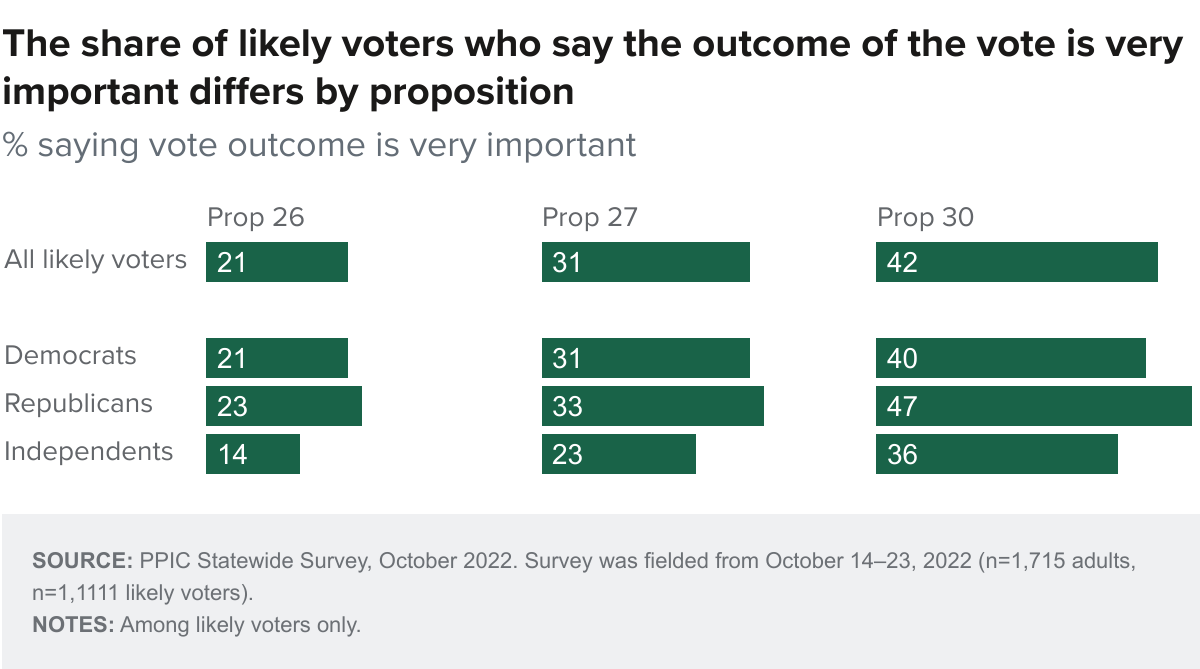
Fewer than half of likely voters say the result of each of these state propositions is very important to them. Today, 21 percent of likely voters say the outcome of Prop 26 is very important, 31 percent say the outcome of Prop 27 is very important, and 42 percent say the outcome of Prop 30 is very important. The shares maxim the outcomes are very important to them have remained like to a month ago for Prop 27 (29%) and Prop xxx (42%). Today, when it comes to the importance of the consequence of Prop 26, i in four or fewer beyond partisan groups say information technology is very important to them. About i in iii across partisan groups say the outcome of Prop 27 is very of import to them. Fewer than one-half across partisan groups say the outcome of Prop xxx is very important to them.
Congressional Elections
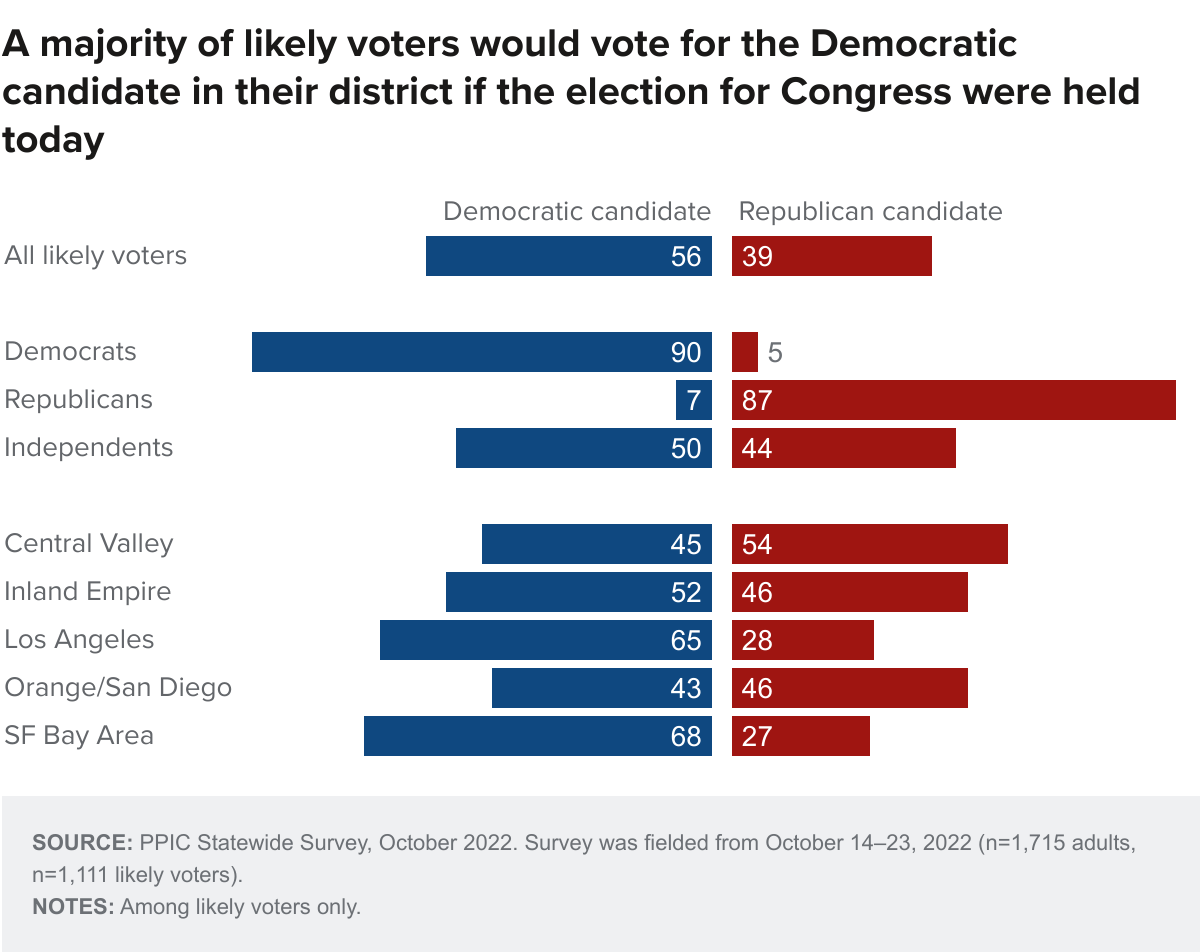
When asked how they would vote if the 2022 election for the US House of Representatives were held today, 56 pct of likely voters say they would vote for or lean toward the Autonomous candidate, while 39 per centum would vote for or lean toward the Republican candidate. In September, a similar share of likely voters preferred the Democratic candidate (60% Democrat/lean Democrat, 34% Republican/lean Republican). Today, overwhelming majorities of partisans back up their political party'due south candidate, while independents are divided (l% Democrat/lean Democrat, 44% Republican/lean Republican). Autonomous candidates are preferred past a 26-betoken margin in Democratic-held districts, while Republican candidates are preferred by a 23-point margin in Republican-held districts. In the ten competitive California districts every bit defined past the Cook Political Report, the Democratic candidate is preferred by a 22-point margin (54% to 32%).
Abortion is another prominent issue in this election. When asked about the importance of ballgame rights, 61 pct of likely voters say the outcome is very important in determining their vote for Congress and some other 20 percent say it is somewhat important; just 17 per centum say it is not too or non at all important. Among partisans, an overwhelming majority of Democrats (78%) and 55 percent of independents say information technology is very important, compared to 43 percent of Republicans. Majorities across regions and all demographic groups—with the exception of men (49% very important)—say abortion rights are very important when making their choice among candidates for Congress.

With the controlling party in Congress hanging in the remainder, 51 percent of likely voters say they are extremely or very enthusiastic about voting for Congress this year; another 29 percentage are somewhat enthusiastic while 19 percent are either not too or not at all enthusiastic. In Oct 2018 before the last midterm ballot, a similar 53 percent of likely voters were extremely or very enthusiastic about voting for Congress (25% extremely, 28% very, 28% somewhat, 10% not too, 8% not at all). Today, Democrats and Republicans have about equal levels of enthusiasm, while independents are much less likely to be extremely or very enthusiastic. Half or more across regions are at least very enthusiastic, with the exceptions of likely voters in Los Angeles (44%) and the San Francisco Bay Area (43%). At to the lowest degree half beyond demographic groups are highly enthusiastic, with the exceptions of likely voters earning $40,000 to $79,999 annually (48%), women (47%), Latinos (43%), those with a high school diploma or less (42%), renters (42%), and xviii- to 44-year-olds (37%).
Democracy and the Political Divide
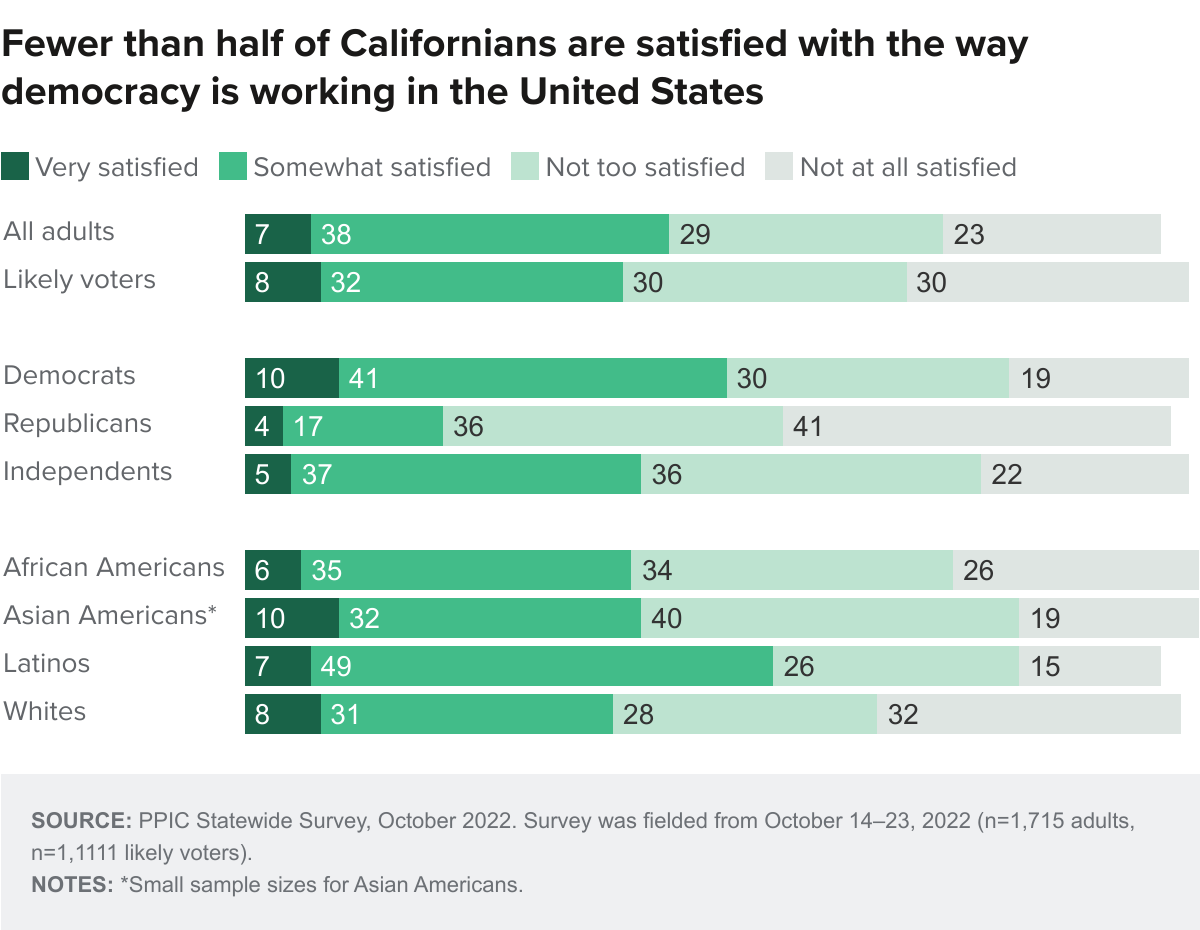
As Californians prepare to vote in the upcoming midterm election, fewer than half of adults and probable voters are satisfied with the way democracy is working in the U.s.a.—and few are very satisfied. Satisfaction was college in our February survey when 53 percentage of adults and 48 percent of likely voters were satisfied with democracy in America. Today, half of Democrats and nigh four in ten independents are satisfied, compared to about ane in five Republicans. Notably, 4 in ten Republicans are not at all satisfied. Across regions, half of residents in the San Francisco Bay Area (52%) and the Inland Empire (50%) are satisfied, compared to fewer elsewhere. Across demographic groups, fewer than half are satisfied, with the exception of Latinos (56%), those with a high school degree or less (55%), and those making less than $40,000 (53%).
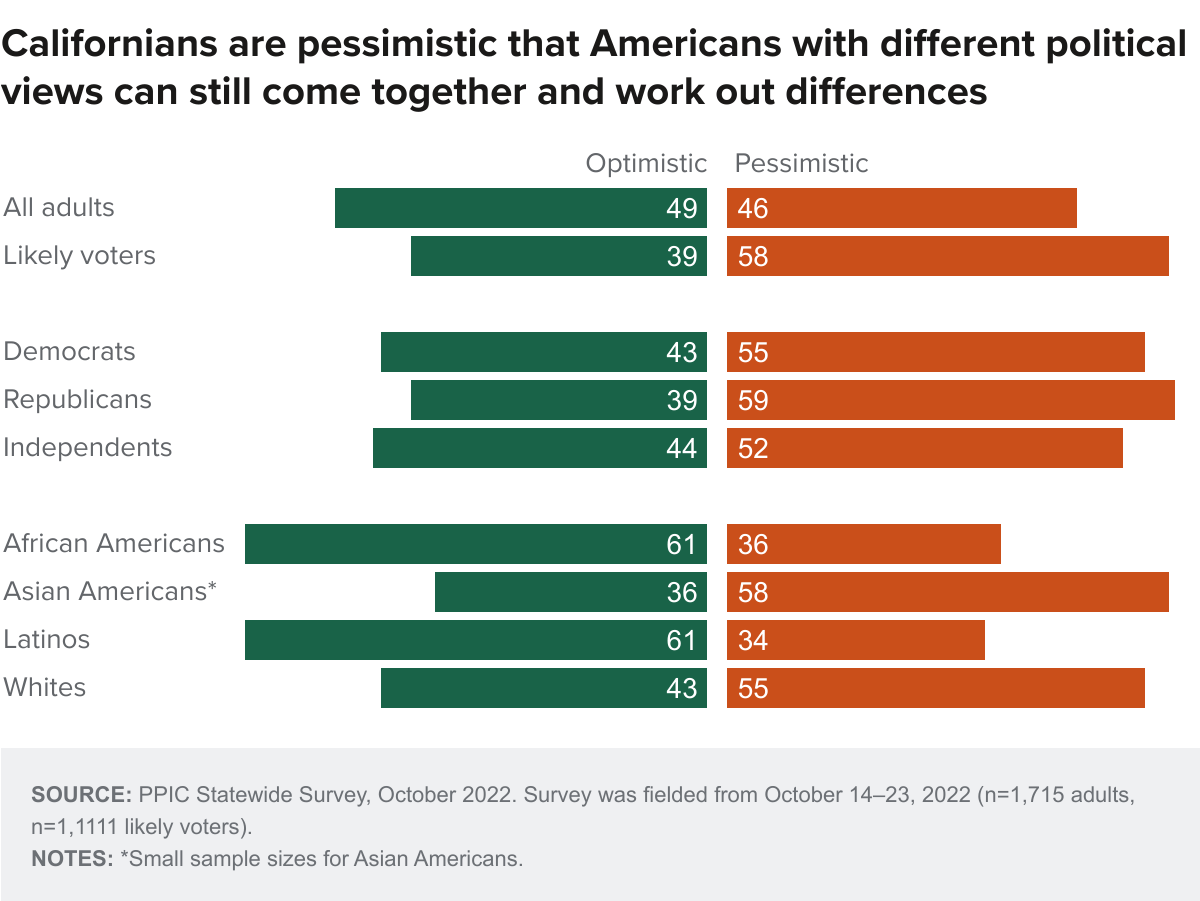
In addition to the lack of satisfaction with the way republic is working, Californians are divided nearly whether Americans of different political positions can all the same come together and work out their differences. Forty-9 percent are optimistic, while 46 percent are pessimistic. Optimism has been similar in more recent years, only has decreased 7 points since we first asked this question in September 2017 (56%). In September 2020, just before the 2020 general election, Californians were also divided (47% optimistic, 49% pessimistic).
Today, in a rare moment of bipartisan agreement, about four in ten Democrats, Republicans, and independents are optimistic that Americans of unlike political views volition be able to come together. Beyond regions, near one-half in Orange/San Diego, the Inland Empire, and the San Francisco Bay Area are optimistic. Across demographic groups, just the following groups have a majority or more who are optimistic: African Americans and Latinos (61% each), those with a high school diploma or less (63%), and those with household incomes under $twoscore,000 (61%). Notably, in 2017, half or more across parties, regions, and demographic groups were optimistic.
Approval Ratings
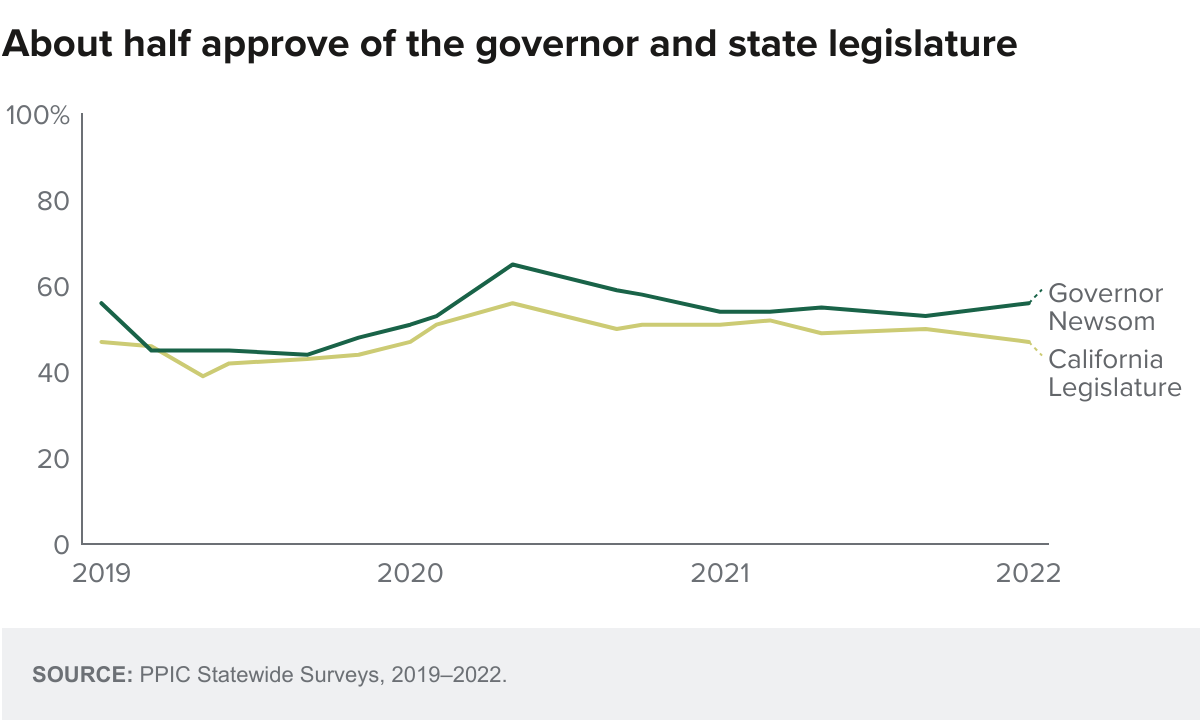
With near two weeks to become before Governor Newsom's bid for reelection, a majority of Californians (54%) and likely voters (52%) corroborate of the style he is handling his job, while fewer disapprove (33% adults, 45% likely voters). Blessing was virtually identical in September (52% adults, 55% likely voters) and has been fifty percent or more than since January 2020. Today, about eight in x Democrats—compared to almost half of independents and about ane in ten Republicans—approve of Governor Newsom. One-half or more across regions corroborate of Newsom, except in the Fundamental Valley (42%). Across demographic groups, almost half or more corroborate of how Governor Newsom is treatment his job.
With all eighty land associates positions and half of state senate seats up for ballot, fewer than one-half of adults (49%) and likely voters (43%) corroborate of the way that the California Legislature is handling its job. Views are deeply divided along partisan lines; blessing is highest in the San Francisco Bay Area and lowest in Orange/San Diego. About one-half across racial/ethnic groups approve, and approval is much college among younger Californians.
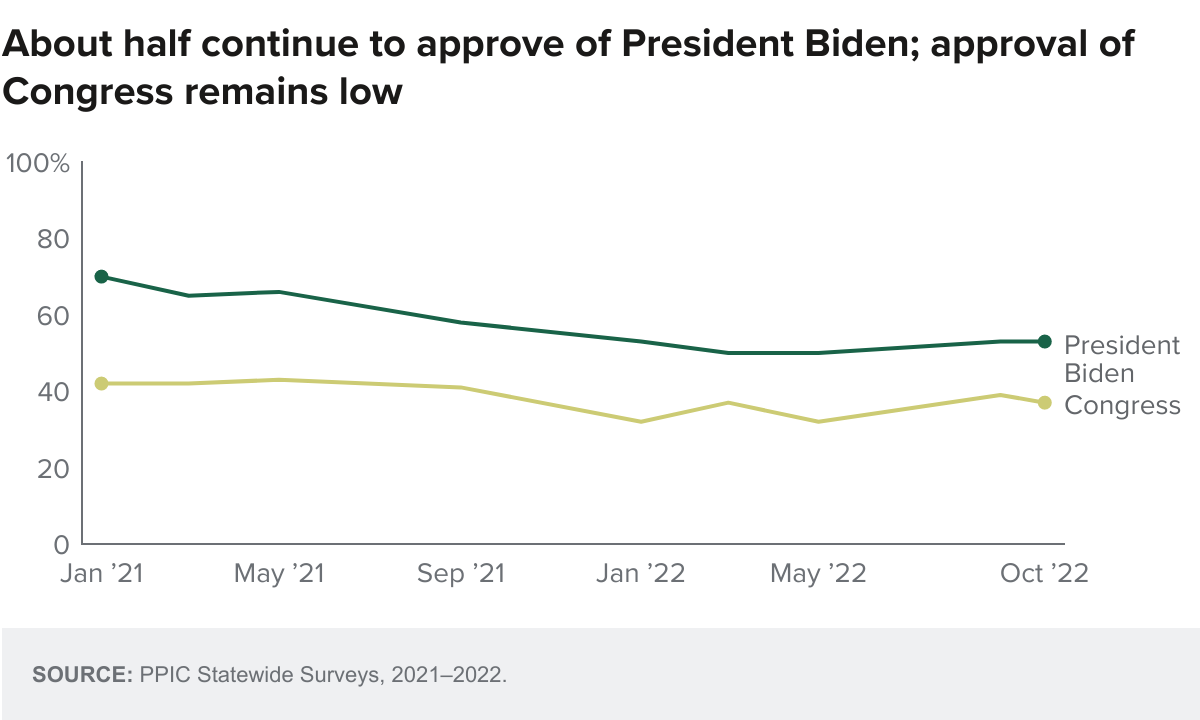
Majorities of California adults (53%) and probable voters (52%) corroborate of the way President Biden is handling his job, while fewer disapprove (43% adults, 47% likely voters). Approval is similar to September (53% adults and probable voters), and Biden's approving rating among adults has been at 50 percentage or college since we showtime asked this question in Jan 2021. Today, about eight in ten Democrats corroborate of Biden's job operation, compared to about four in ten independents and one in ten Republicans. Blessing is higher in the San Francisco Bay Surface area and Los Angeles than in the Inland Empire, Orange/San Diego, and the Central Valley. Nearly half or more beyond demographic groups approve of President Biden, with the exception of those with some college educational activity (44%).
Approving of Congress remains depression, with fewer than four in ten adults (37%) and probable voters (29%) approving. Blessing of Congress among adults has been below 40 percent for all of 2022 after seeing a brief run to a higher place 40 percent for all of 2021. Democrats are far more likely than Republicans to approve of Congress. Fewer than half across regions and demographic groups approve of Congress.
US Senator Alex Padilla is on the California election twice this Nov—once for the remainder of Vice President Harris's term and one time for reelection. Senator Padilla has the blessing of 46 percent of adults and 48 per centum of probable voters (adults: 26% disapprove, 29% don't know; probable voters: 31% disapprove, 22% don't know). Approval in March was at 44 percentage for adults and 39 percent for likely voters. Today, Padilla'south approval rating is much college among Democrats than independents and Republicans. Across regions, about half in the San Francisco Bay Area, Los Angeles, and the Inland Empire approve of the US senator, compared to four in x in Orange/San Diego and i in three in the Fundamental Valley. Across demographic groups, about half or more corroborate among women, younger adults, African Americans, Asian Americans, and Latinos. Views are similar across education and income groups, with just fewer than half blessing.
US Senator Dianne Feinstein—who is not on the California ballot this November—has the approval of 41 percent of adults and likely voters (adults: 42% disapprove, 17% don't know; probable voters: 52% disapprove, 7% don't know). Approval in March was at 41 pct for adults and 36 percent for likely voters. Today, Feinstein's approving rating is far higher among Democrats and independents than Republicans. Across regions, approval reaches a majority but in the San Francisco Bay Area. Across demographic groups, blessing reaches a majority but among African Americans
Topics
2022 Ballot COVID-19 Economic system Health & Safety Net Political Landscape Statewide Survey
Which Layer Is The Coolest,
Source: https://www.ppic.org/publication/ppic-statewide-survey-californians-and-their-government-october-2022/
Posted by: simsraides.blogspot.com
0 Response to "Which Layer Is The Coolest"
Post a Comment