

Two Goats & The Goose
| Domestic goat Temporal range: Neolithic–Recent | |
|---|---|
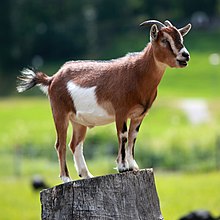 | |
| A pygmy caprine animal on a tree stump | |
| Conservation condition | |
| Domesticated | |
Scientific nomenclature  | |
| Kingdom: | Animalia |
| Phylum: | Chordata |
| Form: | Mammalia |
| Order: | Artiodactyla |
| Family unit: | Bovidae |
| Subfamily: | Caprinae |
| Tribe: | Caprini |
| Genus: | Capra |
| Species: | C. hircus |
| Binomial name | |
| Capra hircus Linnaeus, 1758 | |
| Synonyms | |
| Capra aegagrus hircus Linnaeus, 1758 | |
The goat or domestic goat ( Capra hircus ) is a domesticated species of goat-antelope typically kept as livestock. It was domesticated from the wild goat (C. aegagrus) of Southwest Asia and Eastern Europe. The caprine animal is a fellow member of the creature family Bovidae and the tribe Caprini, significant it is closely related to the sheep. At that place are over 300 singled-out breeds of goat.[1] It is ane of the oldest domesticated species of animal, according to archaeological evidence that its earliest domestication occurred in Iran at 10,000 calibrated calendar years ago.[2]

Goat-herding is an ancient tradition that is still important in places such as Arab republic of egypt.
Goats take been used for milk, meat, fur, and skins across much of the globe.[iii] Milk from goats is often turned into goat cheese.
Female goats are referred to as does or nannies, intact males are chosen bucks or billies, and juvenile goats of both sexes are chosen kids. Castrated males are called wethers. While the words hircine and caprine both refer to annihilation having a caprine animal-like quality, hircine is used most often to emphasize the distinct aroma of domestic goats.
In 2011, there were more than 924 million goats living in the world, co-ordinate to the UN Food and Agriculture System.[4]
Etymology

The Modern English word goat comes from Old English gāt "she-goat, goat in full general", which in turn derives from Proto-Germanic *gaitaz (cf. Norwegian/Icelandic geit, German Geiß, and Gothic gaits), ultimately from Proto-Indo-European *ǵʰaidos meaning "young caprine animal" (cf. Latin haedus "child").[5] To refer to the male, Old English used bucca (giving modern buck) until ousted by hegote, hegoote in the late twelfth century. Nanny goat (females) originated in the 18th century, and baton goat (for males) originated in the 19th century.[ citation needed ]
History

Horn cores from the Neolithic village of Atlit Yam
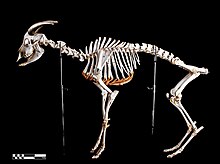
Goats are amid the earliest animals domesticated by humans.[6] The near contempo genetic assay[seven] confirms the archaeological show that the wild bezoar ibex of the Zagros Mountains is the likely original antecedent of probably all domestic goats today.[6]
Neolithic farmers began to herd wild goats primarily for piece of cake access to milk and meat, as well as to their dung, which was used as fuel; and their bones, hair, and sinew were used for clothing, building, and tools.[ane] The primeval remnants of domesticated goats dating ten,000 years Before Present are found in Ganj Dareh in Islamic republic of iran.[viii] Goat remains have been institute at archaeological sites in Jericho, Choga Mami,[9] Djeitun, and Çayönü, dating the domestication of goats in Western asia at between eight,000 and 9,000 years ago.[6]
Studies of DNA prove suggests 10,000 years ago as the domestication date.[seven]
Historically, caprine animal hide has been used for water and wine bottles in both traveling and transporting vino for sale. It has also been used to produce parchment.[ citation needed ]
Anatomy and wellness
Each recognized breed of goat has specific weight ranges, which vary from over 140 kg (300 lb) for bucks of larger breeds such as the Boer, to 20 to 27 kg (45 to lx lb) for smaller goat does.[10] Within each breed, different strains or bloodlines may have different recognized sizes. At the bottom of the size range are miniature breeds such as the African Pygmy, which stand 41 to 58 cm (16 to 23 in) at the shoulder as adults.[xi]
Horns
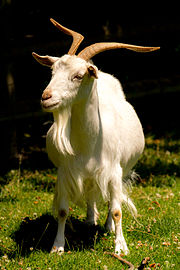
A white Irish goat with horns
Most goats naturally have two horns, of diverse shapes and sizes depending on the breed.[12] In that location take been incidents of polycerate goats (having as many as viii horns), although this is a genetic rarity idea to exist inherited. Unlike cattle, goats have not been successfully bred to be reliably polled, as the genes determining sex activity and those determining horns are closely linked. Breeding together ii genetically polled goats results in a high number of intersex individuals among the offspring, which are typically sterile.[12] Their horns are made of living bone surrounded past keratin and other proteins, and are used for defense, dominance, and territoriality.[13]
Digestion and lactation
Goats are ruminants. They have a four-chambered tum consisting of the rumen, the reticulum, the omasum, and the abomasum. Every bit with other mammal ruminants, they are even-toed ungulates. The females take an udder consisting of ii teats, in contrast to cattle, which have four teats.[14] An exception to this is the Boer caprine animal, which sometimes may take up to eight teats.[15] [16]
Eyes
Goats have horizontal, slit-shaped pupils. Considering goats' irises are usually pale, their contrasting pupils are much more noticeable than in animals such as cattle, deer, most horses, and many sheep, whose similarly horizontal pupils blend into a dark iris and sclera.[ commendation needed ]
Goats have no tear ducts.[17]
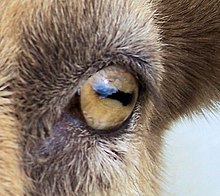
Heart with horizontal pupil
Beards
Both male and female goats may have beards, and many types of caprine animal (nigh usually dairy goats, dairy-cross Boers, and pygmy goats) may accept wattles, one dangling from each side of the neck.[18]
Tan
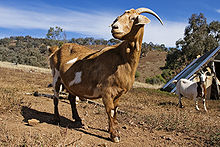
Brown/tan caprine animal with some white spotting
Goats expressing the tan pattern have coats pigmented completely with pheomelanin (tan/brownish pigment). The allele which codes for this pattern is located at the agouti locus of the goat genome. It is completely dominant to all other alleles at this locus. In that location are multiple modifier genes which control how much tan pigment is actually expressed, so a tan-patterned caprine animal can have a coat ranging from pure white to deep red.[ citation needed ]

Goat heart. Specimen clarified for visualization of anatomical structures
Reproduction

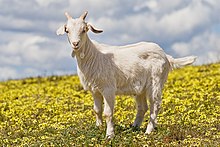
A 2-month-old caprine animal kid in a field of capeweed
Goats reach puberty between 3 and 15 months of age, depending on breed and nutritional status. Many breeders prefer to postpone breeding until the doe has reached lxx% of the adult weight. Nonetheless, this separation is rarely possible in extensively managed, open-range herds.[19]
In temperate climates and among the Swiss breeds, the breeding season commences as the day length shortens, and ends in early spring or before. In equatorial regions, goats are able to breed at any time of the year. Successful breeding in these regions depends more on bachelor forage than on day length. Does of any brood or region come up into estrus (estrus) every 21 days for two to 48 hours. A doe in rut typically flags (vigorously wags) her tail often, stays most the buck if ane is present, becomes more than vocal, and may also show a decrease in appetite and milk production for the elapsing of the oestrus.

A female goat and two kids
Bucks (intact males) of Swiss and northern breeds come into estrus in the fall as with the does' heat cycles. Bucks of equatorial breeds may show seasonal reduced fertility, merely every bit with the does, are capable of breeding at all times. Rut is characterized by a decrease in ambition and obsessive interest in the does.[xiii] A buck in oestrus will display flehmen lip curling and will urinate on his forelegs and face.[twenty] Sebaceous olfactory property glands at the base of the horns add to the male caprine animal's odor, which is important to brand him attractive to the female person. Some does will not mate with a buck which has been descented.[13]
In addition to natural, traditional mating, artificial insemination has gained popularity among goat breeders, as information technology allows easy access to a broad variety of bloodlines.
Gestation length is approximately 150 days. Twins are the usual result, with unmarried and triplet births as well common. Less frequent are litters of quadruplet, quintuplet, and fifty-fifty sextuplet kids. Birthing, known every bit kidding, more often than not occurs uneventfully. Just earlier kidding, the doe volition accept a sunken area around the tail and hip, likewise every bit heavy animate. She may have a worried await, get restless and display swell amore for her keeper. The mother often eats the placenta, which gives her much-needed nutrients, helps stanch her haemorrhage, and parallels the beliefs of wild herbivores, such as deer, to reduce the lure of the birth scent for predators.[21] [22]
Freshening (coming into milk production) occurs at kidding. Milk product varies with the brood, age, quality, and diet of the doe; dairy goats by and large produce between 680 and 1,810 kg (1,500 and 4,000 lb) of milk per 305-day lactation. On average, a good quality dairy doe will give at least 3 kg (6 lb) of milk per day while she is in milk. A first-time milker may produce less, or as much every bit vii kg (16 lb), or more of milk in exceptional cases. After the lactation, the doe will "dry out off", typically after she has been bred. Occasionally, goats that have non been bred and are continuously milked volition continue lactation beyond the typical 305 days.[23] Meat, fiber, and pet breeds are not unremarkably milked and simply produce enough for the kids until weaning.
Male lactation is also known to occur in goats.[24]
Diet
Goats are reputed to be willing to eat almost anything, including tin cans and cardboard boxes. While goats will not really eat inedible fabric, they are browsing animals, not grazers similar cattle and sheep, and (coupled with their highly curious nature) will chew on and taste just well-nigh anything remotely resembling constitute affair to determine whether information technology is expert to eat, including cardboard, clothing and newspaper (such as labels from tin cans).[25]
Aside from sampling many things, goats are quite detail in what they actually consume, preferring to browse on the tips of woody shrubs and trees, every bit well as the occasional wide-leaved institute. Even so, information technology can adequately be said that their plant diet is extremely varied, and includes some species which are otherwise toxic.[26] They volition seldom consume soiled food or contaminated water unless facing starvation. This is one reason caprine animal-rearing is near frequently gratuitous-ranging, since stall-fed caprine animal-rearing involves all-encompassing upkeep and is seldom commercially viable.[ citation needed ]

A domestic caprine animal feeding in a field of capeweed, a weed which is toxic to most stock animals
Goats prefer to browse on vines, such as kudzu, on shrubbery and on weeds, more like deer than sheep, preferring them to grasses. Nightshade is poisonous; wilted fruit tree leaves can also kill goats. Silage (fermented corn stalks) and haylage (fermented grass hay) can exist used if consumed immediately after opening – goats are particularly sensitive to Listeria bacteria that can grow in fermented feeds. Alfalfa, a loftier-protein plant, is widely fed as hay; fescue is the least palatable and least nutritious hay. Mold in a goat'southward feed can make it sick and possibly kill it. In diverse places in Prc, goats are used in the product of tea. Goats are released onto the tea terraces where they avoid consuming the green tea leaves (which contain bitter tasting substances), simply instead eat the weeds. The goats' debris fertilise the tea plants.[27]
The digestive physiology of a very immature kid (like the young of other ruminants) is substantially the aforementioned every bit that of a monogastric animal. Milk digestion begins in the abomasum, the milk having bypassed the rumen via closure of the reticuloesophageal groove during suckling. At nativity, the rumen is undeveloped, but as the kid begins to consume solid feed, the rumen before long increases in size and in its capacity to blot nutrients.[28]
The adult size of a item caprine animal is a product of its breed (genetic potential) and its diet while growing (nutritional potential). As with all livestock, increased poly peptide diets (10 to 14%) and sufficient calories during the prepuberty period yield college growth rates and larger eventual size than lower protein rates and express calories.[29] Large-framed goats, with a greater skeletal size, reach mature weight at a later historic period (36 to 42 months) than small-framed goats (18 to 24 months) if both are fed to their full potential. Large-framed goats need more calories than small-framed goats for maintenance of daily functions.[xxx]
Behavior
An case of goats browsing together in Japan.

Goats blocking a route in Ladakh

Goats are naturally curious. They are likewise agile and well known for their power to climb and balance in precarious places. This makes them the simply ruminant to regularly climb copse. Due to their agility and inquisitiveness, they are notorious for escaping their pens by testing fences and enclosures, either intentionally or merely considering they are used to climbing. If any of the fencing can be overcome, goats volition about inevitably escape. Goats take been found to be equally intelligent equally dogs by some studies.[31]
When handled equally a group, goats tend to display less herding beliefs than sheep. When grazing undisturbed, they tend to spread across the field or range, rather than feed side by side as do sheep. When nursing young, goats will leave their kids separated ("lying out") rather than clumped, every bit do sheep. They will generally turn and face an intruder and bucks are more likely to charge or butt at humans than are rams.[32]
A study past Queen Mary University reports that goats endeavour to communicate with people in the same style as domesticated animals such equally dogs and horses. Goats were first domesticated every bit livestock more than than 10,000 years ago. Research conducted to test communication skills found that the goats volition look to a human for assistance when faced with a claiming that had previously been mastered, only was then modified. Specifically, when presented with a box, the goat was able to remove the lid and remember a care for within, but when the box was turned and so the lid could non be removed, the goat would turn and gaze at the person and move toward them, before looking back toward the box. This is the same type of complex communication observed by animals bred as domestic pets, such as dogs. Researchers believe that meliorate agreement of human-goat interaction could offer overall improvement in the animals' welfare.[33] [34] The field of anthrozoology has established that domesticated animals have the capacity for circuitous advice with humans when in 2015 a Japanese scientist determined that levels of oxytocin did increase in human being subjects when dogs were exposed to a dose of the "love hormone", proving that a human-beast bond does be. This is the aforementioned affinity that was proven with the London study above; goats are intelligent, capable of complex advice, and able to course bonds.[35]
Diseases
While goats are generally considered hardy animals and in many situations receive petty medical care, they are subject to a number of diseases. Amongst the conditions affecting goats are respiratory diseases including pneumonia, foot rot, internal parasites, pregnancy toxicosis, and feed toxicity. Feed toxicity tin can vary based on breed and location. Certain foreign fruits and vegetables tin can be toxic to different breeds of goats.[ citation needed ]
Goats tin become infected with various viral and bacterial diseases, such as human foot-and-oral cavity affliction, caprine arthritis encephalitis, caseous lymphadenitis, pinkeye, mastitis, and pseudorabies. They tin can transmit a number of zoonotic diseases to people, such as tuberculosis, brucellosis, Q fever, and rabies.[36]
Life expectancy
Life expectancy for goats is betwixt xv and 18 years.[37] An instance of a goat reaching the age of 24 has been reported.[38]
Several factors can reduce this average expectancy; problems during kidding can lower a doe'south expected life span to x or eleven, and stresses of going into rut tin can lower a buck's expected life span to eight to 10 years.[38]
Agronomics
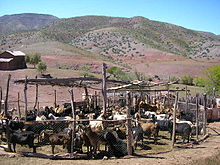
A goat is useful to humans when it is living and when information technology is expressionless, offset equally a renewable provider of milk, manure, and fiber, and and then as meat and hide.[39] Some charities provide goats to impoverished people in poor countries, because goats are easier and cheaper to manage than cattle, and accept multiple uses. In add-on, goats are used for driving and packing purposes.
The intestine of goats is used to make "catgut", which is all the same in use equally a material for internal human surgical sutures and strings for musical instruments. The horn of the goat, which signifies enough and wellbeing (the cornucopia), is also used to make spoons.[40]
Worldwide population statistics
Co-ordinate to the Nutrient and Agronomics Organization (FAO), the summit producers of goat milk in 2008 were India (4 million metric tons), People's republic of bangladesh (2.16 meg metric tons), and the Sudan (one.47 million metric tons).[41] Bharat slaughters 41% of 124.iv million goats each year. The 0.half-dozen meg metric tonnes of goat meat make up viii% of Bharat'south almanac meat product.[42] Approximately 440 one thousand thousand goats are slaughtered each twelvemonth for meat worldwide.[43]
Husbandry

Species-appropriate caprine animal husbandry with stable and hay rack
Husbandry, or animal care and use, varies by region and culture. The particular housing used for goats depends not but on the intended use of the goat, but also on the region of the world where they are raised. Historically, domestic goats were generally kept in herds that wandered on hills or other grazing areas, often tended by goatherds who were ofttimes children or adolescents, similar to the more widely known shepherd. These methods of herding are still used today.
In some parts of the world, especially Europe and North America, distinct breeds of goats are kept for dairy (milk) and for meat production. Backlog male kids of dairy breeds are typically slaughtered for meat. Both does and bucks of meat breeds may exist slaughtered for meat, every bit well as older animals of whatsoever breed. The meat of older bucks (more one year erstwhile) is generally considered not desirable for meat for human consumption. Castration at a young age prevents the evolution of typical buck odour.

Dairy goats are by and large pastured in summer and may be stabled during the wintertime. As dairy does are milked daily, they are generally kept close to the milking shed. Their grazing is typically supplemented with hay and concentrates. Stabled goats may exist kept in stalls like to horses, or in larger group pens. In the The states system, does are by and large rebred annually. In some European commercial dairy systems, the does are bred only twice, and are milked continuously for several years after the second kidding.
Meat goats are more frequently pastured twelvemonth-round, and may be kept many miles from barns. Angora and other fiber breeds are likewise kept on pasture or range. Range-kept and pastured goats may exist supplemented with hay or concentrates, most often during the winter or dry seasons.
In the Indian subcontinent and much of Asia, goats are kept largely for milk production, both in commercial and household settings. The goats in this area may be kept closely housed or may be allowed to range for fodder. The Salem Blackness goat is herded to pasture in fields and along roads during the 24-hour interval, but is kept penned at night for safe-keeping.[44]
In Africa and the Mideast, goats are typically run in flocks with sheep. This maximizes the product per acre, every bit goats and sheep adopt dissimilar nutrient plants. Multiple types of goat-raising are found in Ethiopia, where 4 main types have been identified: pastured in almanac crop systems, in perennial crop systems, with cattle, and in arid areas, under pastoral (nomadic) herding systems. In all iv systems, all the same, goats were typically kept in extensive systems, with few purchased inputs.[45] Household goats are traditionally kept in Nigeria. While many goats are immune to wander the homestead or village, others are kept penned and fed in what is called a 'cut-and-carry' system. This type of husbandry is also used in parts of Latin America. Cutting-and-carry, which refers to the practise of cutting down grasses, corn or cane for feed rather than allowing the animal access to the field, is particularly suited for types of feed, such equally corn or pikestaff, that are easily destroyed by trampling.[46]
Pet goats may be establish in many parts of the world when a family keeps one or more animals for emotional reasons rather than every bit product animals. It is becoming more than common for goats to be kept exclusively equally pets in Due north America and Europe.
Meat

The Boer caprine animal – in this case a cadet – is a widely kept meat breed.
The sense of taste of caprine animal kid meat is similar to that of spring lamb meat;[47] in fact, in the English-speaking islands of the Caribbean, and in some parts of Asia, particularly People's republic of bangladesh, Pakistan, and Bharat, the give-and-take "mutton" is used to describe both goat and sheep meat. However, some compare the taste of goat meat to veal or venison, depending on the age and condition of the goat. Its flavor is said to exist primarily linked to the presence of 4-methyloctanoic and 4-methylnonanoic acid.[48] Information technology tin can be prepared in a variety of ways, including stewing, blistering, grilling, barbecuing, canning, and frying; information technology can be minced, curried, or made into sausage. Due to its low fat content, the meat tin can toughen at loftier temperatures if cooked without additional moisture. I of the virtually popular goats grown for meat is the South African Boer, introduced into the United States in the early 1990s. The New Zealand Kiko is also considered a meat breed, equally is the myotonic or "fainting caprine animal", a brood originating in Tennessee.
Milk, butter, and cheese
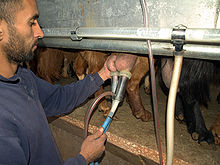
Goats produce about ii% of the world'due south total annual milk supply.[49] Some goats are bred specifically for milk. If the stiff-smelling buck is not separated from the does, his olfactory property volition touch on the milk.
Goat milk naturally has small, well-emulsified fat globules, which means the foam remains suspended in the milk, instead of rising to the meridian, every bit in raw moo-cow milk; therefore, it does non demand to be homogenized. Indeed, if the milk is to be used to make cheese, homogenization is not recommended, every bit this changes the structure of the milk, affecting the civilization's ability to coagulate the milk and the concluding quality and yield of cheese.[50]
Dairy goats in their prime (generally around the 3rd or 4th lactation cycle) average—2.7 to iii.6 kg (6 to viii lb)—of milk production daily—roughly two.8 to three.8 l (iii to four U.S. qt)—during a ten-month lactation, producing more just after freshening and gradually dropping in production toward the end of their lactation. The milk generally averages iii.5% butterfat.[51]
Goat milk is commonly processed into cheese, butter, ice cream, yogurt, cajeta and other products. Goat cheese is known as fromage de chèvre ("goat cheese") in French republic. Some varieties include Rocamadour and Montrachet.[52] Goat butter is white because goats produce milk with the yellow beta-carotene converted to a colorless form of vitamin A. Goat milk has less cholesterol than cow's milk.[53]
Diet
The American University of Pediatrics discourages feeding infants milk derived from goats. An April 2010 case report[54] summarizes their recommendation and presents "a comprehensive review of the consequences associated with this dangerous practice", also stating, "Many infants are exclusively fed unmodified caprine animal'south milk as a result of cultural beliefs also as exposure to faux online information. Anecdotal reports have described a host of morbidities associated with that do, including severe electrolyte abnormalities, metabolic acidosis, megaloblastic anemia, allergic reactions including life-threatening anaphylactic shock, hemolytic uremic syndrome, and infections." Untreated caprine brucellosis results in a 2% instance fatality charge per unit. Co-ordinate to the USDA, doe milk is not recommended for human infants because it contains "inadequate quantities of iron, folate, vitamins C and D, thiamine, niacin, vitamin Bsix, and pantothenic acid to come across an baby's nutritional needs" and may cause harm to an infant'southward kidneys and could crusade metabolic harm.[55]
The section of health in the United Kingdom has repeatedly released statements stating on various occasions that[56] "Goats' milk is non suitable for babies, and infant formulas and follow-on formulas based on goats' milk protein have not been approved for use in Europe", and "infant milks based on goats' milk protein are non suitable equally a source of nutrition for infants."[57] Moreover, according to the Canadian federal health department Health Canada, most of the dangers of, and counter-indications for, feeding unmodified goat's milk to infants parallel those associated with unmodified cow'south milk — especially insofar every bit allergic reactions go.[58]
However, some farming groups promote the do. For example, Small Farm Today, in 2005, claimed beneficial use in invalid and ambulatory diets, proposing that glycerol ethers, mayhap of import in nutrition for nursing infants, are much higher in does' milk than in cows' milk.[59] A 1970 volume on brute breeding claimed that does' milk differs from cows' or humans' milk by having college digestibility, distinct alkalinity, higher buffering capacity, and certain therapeutic values in human being medicine and nutrition.[60] George Mateljan suggested doe milk can replace ewe milk or cow milk in diets of those who are allergic to certain mammals' milk.[61] However, like cow milk, doe milk has lactose (sugar), and may cause gastrointestinal problems for individuals with lactose intolerance.[61] In fact, the level of lactose is similar to that of cow milk.[57]
Some researchers and companies producing goat's milk products have made claims that caprine animal'south milk is better for human health than most Western cow's milk due to it generally defective a class of β-casein proteins called A1, and instead mostly containing the A2 form, which does not metabolize to β-casomorphin 7 in the body.[62] [63] [64] [65]
| Elective | Doe (goat) | Cow | Human |
|---|---|---|---|
| Fat (yard) | 3.8 | iii.6 | 4.0 |
| Protein (k) | 3.5 | 3.3 | i.2 |
| Lactose (k) | 4.1 | 4.6 | 6.ix |
| Ash (g) | 0.eight | 0.7 | 0.2 |
| Total solids (k) | 12.2 | 12.3 | 12.3 |
| Calories | 70 | 69 | 68 |
| Constituents | Unit of measurement | Cow | Doe (goat) | Ewe (sheep) | Water buffalo |
|---|---|---|---|---|---|
| Water | g | 87.eight | 88.9 | 83.0 | 81.1 |
| Protein | g | 3.2 | 3.1 | 5.iv | 4.v |
| Fat | thousand | three.9 | iii.5 | vi.0 | viii.0 |
| Carbohydrates | g | 4.8 | iv.iv | five.1 | 4.9 |
| Energy | kcal | 66 | 60 | 95 | 110 |
| Energy | kJ | 275 | 253 | 396 | 463 |
| Sugars (lactose) | g | 4.8 | 4.4 | 5.1 | 4.ix |
| Cholesterol | mg | 14 | 10 | eleven | eight |
| Calcium | IU | 120 | 100 | 170 | 195 |
| Saturated fatty acids | g | two.4 | 2.3 | 3.viii | four.2 |
| Monounsaturated fat acids | g | 1.one | 0.8 | ane.v | 1.7 |
| Polyunsaturated fatty acids | m | 0.1 | 0.ane | 0.3 | 0.2 |
These compositions vary by breed (particularly in the Nigerian Dwarf breed), animal, and indicate in the lactation menstruation.
Fiber
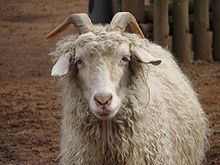
The Angora breed of goats produces long, curling, lustrous locks of mohair. The entire body of the goat is covered with mohair and there are no baby-sit hairs. The locks constantly grow to four inches or more in length. Angora crossbreeds, such as the pygora and the nigora, take been created to produce mohair and/or cashgora on a smaller, easier-to-manage brute. The wool is shorn twice a year, with an average yield of about iv.five kg (x lb).
Most goats have softer insulating hairs nearer the skin, and longer guard hairs on the surface. The desirable fiber for the textile industry is the former, and it goes past several names (downwardly, cashmere and pashmina). The coarse guard hairs are of little value as they are too coarse, hard to spin and difficult to dye. The cashmere caprine animal produces a commercial quantity of cashmere wool, which is one of the most expensive natural fibers commercially produced; cashmere is very fine and soft. The cashmere goat fiber is harvested once a year, yielding around 260 thousand (nine oz) of down.
In South Asia, cashmere is called "pashmina" (from Persian pashmina, "fine wool"). In the 18th and early 19th centuries, Kashmir (then called Cashmere by the British), had a thriving industry producing shawls from goat-hair imported from Tibet and Tartary through Ladakh. The shawls were introduced into Western Europe when the General in Chief of the French entrada in Egypt (1799–1802) sent 1 to Paris. Since these shawls were produced in the upper Kashmir and Ladakh region, the wool came to be known equally "cashmere".
Land clearing

Goats managing the landscape alongside German autobahn A59.
Goats have been used by humans to clear unwanted vegetation for centuries. They take been described as "eating machines" and "biological control agents".[68] [69] There has been a resurgence of this in N America since 1990, when herds were used to clear dry brush from California hillsides thought to be endangered by potential wildfires. This form of using goats to clear land is sometimes known as conservation grazing. Since and then, numerous public and private agencies have hired private herds from companies such as Hire A Caprine animal to perform like tasks.[68] [70] This may be expensive and their smell may be a nuisance.[71] This practise has become pop in the Pacific Northwest, where they are used to remove invasive species not hands removed past humans, including (thorned) blackberry vines and poisonous substance oak.[68] [72] [73] Chattanooga, TN and Spartanburg, SC have used goats to control kudzu, an invasive establish species prevalent in the southeastern United States.[74]
Medical training
As a caprine animal's anatomy and physiology is non too dissimilar from that of humans, some countries' militaries use goats to train gainsay medics. In the United states, goats accept become the principal animal species used for this purpose subsequently the Pentagon phased out using dogs for medical grooming in the 1980s.[75] While modern mannequins used in medical training are quite efficient in simulating the behavior of a human trunk, trainees feel that "the goat exercise provide[south] a sense of urgency that merely real life trauma can provide".[76]
Pets

Some people choose goats every bit a pet because of their ability to form close bonds with their human guardians.[77] [78] Goats are social animals and usually prefer the company of other goats, simply because of their herd mentality, they will follow their possessor and form close bonds with them, hence their continuing popularity.[33]
Goats are similar to deer with regard to nutrition and demand a wide range of food, including things similar hay, chaffhaye, grain feed or pelleted grain mix, and loose minerals.[79] Goats by and large either inherit certain feeding preferences or learn them later birth.[80]
Breeds
Caprine animal breeds fall into overlapping, general categories. They are generally distributed in those used for dairy, fiber, meat, skins, and as companion animals. Some breeds are likewise peculiarly noted as pack goats.
Showing

A Nigerian Dwarf milker in show clip. This doe is athwart and dairy with a capacious and well supported mammary system.
Goat breeders' clubs frequently hold shows, where goats are judged on traits relating to conformation, udder quality, evidence of high production, longevity, build and muscling (meat goats and pet goats) and fiber production and the fiber itself (fiber goats). People who evidence their goats usually keep registered stock and the offspring of award-winning animals command a higher price. Registered goats, in general, are usually higher-priced if for no other reason than that records accept been kept proving their ancestry and the production and other information of their sires, dams, and other ancestors. A registered doe is usually less of a run a risk than ownership a doe at random (as at an auction or sale befouled) because of these records and the reputation of the breeder. Children's clubs such as 4-H also let goats to exist shown. Children'due south shows frequently include a showmanship class, where the cleanliness and presentation of both the animate being and the exhibitor equally well as the handler'southward ability and skill in handling the caprine animal are scored. In a showmanship course, conformation is irrelevant since this is non what is existence judged.
Diverse "Dairy Goat Scorecards" (milking does) are systems used for judging shows in the United states. The American Dairy Goat Association (ADGA) scorecard for an adult doe includes a bespeak organisation of a hundred total with major categories that include general appearance, the dairy character of a doe (physical traits that aid and increase milk product), trunk capacity, and specifically for the mammary system. Young stock and bucks are judged by different scorecards which identify more emphasis on the other iii categories; full general advent, trunk capacity, and dairy character.
The American Goat Gild (AGS) has a similar, simply not identical scorecard that is used in their shows. The miniature dairy goats may be judged past either of the two scorecards. The "Angora Caprine animal scorecard" used by the Colored Angora Caprine animal Breeder's Association (CAGBA), which covers the white and the colored goats, includes evaluation of an animal'southward fleece color, density, uniformity, fineness, and general body confirmation. Disqualifications include: a deformed mouth, broken down pasterns, deformed feet, crooked legs, abnormalities of testicles, missing testicles, more than 3 inch divide in scrotum, and close-set or distorted horns.
Mythology and folklore

An ancient Greek oenochoe depicting wild goats

Glazed brick depicting a wild goat, from Nimrud, Iraq, 9th–7th century BCE. Iraq Museum
Archaeologists excavating the ancient city of Ebla in Syrian arab republic discovered, among others, the tomb of some king or great noble which included a throne decorated with statuary goat heads. That led to this tomb becoming known as "The Tomb of the Lord of the Goats".[81] [82]
According to Norse mythology, the god of thunder, Thor, has a chariot that is pulled by the goats Tanngrisnir and Tanngnjóstr.[83] At night when he sets upward camp, Thor eats the meat of the goats, but takes intendance that all bones remain whole. Then he wraps the remains up, and in the morn, the goats always come back to life to pull the chariot. When a farmer'south son who is invited to share the meal breaks one of the goats' leg bones to suck the marrow, the animal'southward leg remains broken in the morning, and the male child is forced to serve Thor equally a servant to compensate for the damage.
Possibly related, the Yule Goat is ane of the oldest Scandinavian and Northern European Yule and Christmas symbols and traditions. Yule Caprine animal originally denoted the goat that was slaughtered around Yule, but it may also indicate a caprine animal figure fabricated out of harbinger. It is as well used about the custom of going door-to-door singing carols and getting food and drinks in render, frequently fruit, cakes and sweets. "Going Yule Goat" is similar to the British custom wassailing, both with infidel roots. The Gävle Goat is a giant version of the Yule Goat, erected every year in the Swedish metropolis of Gävle.
The Greek god Pan is said to accept the upper body of a human and the horns and lower body of a goat.[83] Pan was a very lustful god, nearly all of the myths involving him had to practise with him chasing nymphs. He is as well credited with creating the pan flute.
The goat is ane of the 12-year bike of animals which appear in the Chinese zodiac related to the Chinese calendar. Each beast is associated with certain personality traits; those born in a year of the goat are predicted to be shy, introverted, creative, and perfectionist.

Several mythological hybrid creatures are believed to consist of parts of the goat, including the Bubble. The Capricorn sign in the Western zodiac is usually depicted as a goat with a fish'south tail. Fauns and satyrs are mythological creatures that are function goat and part human being. The mineral bromine is named from the Greek word "brόmos", which ways "stench of he-goats".
Popular Christian folk tradition in Europe associated Satan with imagery of goats.[83] A common superstition in the Eye Ages was that goats whispered lewd sentences in the ears of the saints. The origin of this belief was probably the behavior of the buck in rut, the very paradigm of lust. The common medieval depiction of the devil was that of a goat-similar confront with horns and small beard (a goatee). The Black Mass, a probably mythological "Satanic mass", involved Satan manifesting as a blackness goat for worship.
The goat has had a lingering connection with Satanism and heathen religions, fifty-fifty into modern times. The inverted pentagram, a symbol used in Satanism, is said to exist shaped like a goat'south head. The "Baphomet of Mendes" refers to a Satanic goat-like effigy from 19th-century occultism.

A goat in the coat of arms Geta, a municipality of Åland
In Republic of finland the tradition of Nuutinpäivä—St. Knut's Day, January 13—involves young men dressed as goats (Finnish: Nuuttipukki) who visit houses. Usually the dress was an inverted fur jacket, a leather or birch bark mask, and horns. Different the analogues Santa Claus, Nuuttipukki was a scary character (cf. Krampus). The men dressed equally Nuuttipukki wandered from house to house, came in, and typically demanded food from the household and especially leftover alcoholic beverages. In Finland the Nuuttipukki tradition is still kept live in areas of Satakunta, Southwest Finland and Ostrobothnia. However, nowadays the graphic symbol is usually played past children and at present involves a happy encounter.[84]
The common Russian surname Kozlov (Russian: Козло́в), ways "caprine animal". Goatee refers to a way of facial hair incorporating hair on a man'southward chin, so named because of some similarity to a goat's facial feature.
Religion

Goats are mentioned many times in the Bible. Their importance in aboriginal Israel is indicated by the seven different Hebrew and 3 Greek terms used in the Bible.[85] A goat is considered a "clean" animal by Jewish dietary laws and a child was slaughtered for an honored guest. It was too adequate for some kinds of sacrifices. Goat-hair curtains were used in the tent that contained the tabernacle (Exodus 25:4). Its horns tin exist used instead of sheep's horn to make a shofar.[86] On Yom Kippur, the festival of the Day of Atonement, two goats were called and lots were drawn for them. Ane was sacrificed and the other allowed to escape into the wilderness, symbolically carrying with it the sins of the community. From this comes the discussion "scapegoat". A leader or king was sometimes compared to a male goat leading the flock.[ citation needed ]
In Matthew 25:31–46, Jesus said that similar a shepherd he will divide the nations placing on his right hand the sheep, those who take shown kindness to needy and suffering disciples of Jesus and others. These he will reward, just the goats at his left hand, who failed to show kindness, will be punished. Although both sheep and goats were valued as livestock, this preference for sheep may chronicle to the importance of wool and the superior meat of adult sheep compared to the poor meat of adult goats.[85]
Satanism


The Satanic Temple alternative logo, featuring a modern rendition and inspiration of the Sigil of Baphomet.
In some depictions the devil is depicted, similar Baphomet, as a goat, therefore the goat and goat'due south head is a significant symbol throughout Satanism. The inverted pentagram is the symbol used for Satanism, sometimes depicted with the goat's head of Baphomet within it, which originated from the Church of Satan. The caprine animal's head and caput of Baphomet is too used in the logo for The Satanic Temple, which also featured the inverted pentagram.
Feral goats

Goats readily revert to the wild (get feral) if given the opportunity. The only domestic animal known to return to feral life as swiftly is the cat.[6] Feral goats take established themselves in many areas: they occur in Commonwealth of australia, New Zealand, Great Britain, the Galapagos and in many other places. When feral goats reach large populations in habitats which provide unlimited water supply and which practise not incorporate sufficient large predators or which are otherwise vulnerable to goats' aggressive grazing habits, they may have serious furnishings, such as removing native scrub, trees and other vegetation which is required past a wide range of other creatures, not just other grazing or browsing animals. Feral goats are extremely common in Australia, with an estimated ii.half-dozen million in the mid-1990s.[87] Even so, in other circumstances where predator pressure is maintained, they may exist accommodated into some remainder in the local food web.[ citation needed ]
See also
- Goat tower
- Sheep–goat hybrid
References
- ^ a b Hirst, One thousand. Kris. "The History of the Domestication of Goats". About.com. Accessed Baronial 18, 2008.
- ^ Zeder, Melinda A.; Hesse, Brian (2000). "The Initial Domestication of Goats (Capra hircus) in the Zagros Mountains 10,000 Years Ago". Science. 287 (5461): 2254–seven. Bibcode:2000Sci...287.2254Z. doi:ten.1126/science.287.5461.2254. PMID 10731145.
- ^ Coffey, Linda; Unhurt, Margo; Wells, Ann (August 2004). "Goats: Sustainable Production Overview". attra.ncat.org. Archived from the original on February four, 2007.
- ^ FAOSTAT, United nations Food and Agriculture Organization, archived from the original on January 25, 2016, retrieved January 19, 2014
- ^ Calvert Watkins et al., The American Heritage Dictionary (1975, edited by William Morris).
- ^ a b c d "Breeds of Livestock; Goats: (Capra hircus)". Oklahoma State University Board of Regents.
- ^ a b Naderi, Saeid; Rezaei, Hamid-Reza; Pompanon, François; Blum, Michael One thousand. B.; Negrini, Riccardo; Naghash, Hamid-Reza; Balkiz, Özge; Mashkour, Marjan; Gaggiotti, Oscar E.; Ajmone-Marsan, Paolo; Kence, Aykut; Vigne, Jean-Denis; Taberlet, Pierre (November 18, 2008). "The caprine animal domestication process inferred from large-calibration mitochondrial DNA analysis of wild and domestic individuals". PNAS. 105 (46): 17659–17664. Bibcode:2008PNAS..10517659N. doi:10.1073/pnas.0804782105. PMC2584717. PMID 19004765.
- ^ Trinity College Dublin (June vii, 2021). "10,000-yr-erstwhile Dna pens the outset tales of the earliest domesticated goats". Phys.org.
- ^ Maisels, C.K. Well-nigh East: Archaeology in the 'Cradle of Civilization' The Virtually East: Archaeology in the Cradle of Civilization Routledge, 1999; p.124
- ^ Taylor, R.E. and Field, T.G., "Growth and Evolution" Scientific Farm Animal Production: An Introduction to Animal Science, sixth Ed. Prentice-Hall (1999) Upper Saddle River pg 321–324.
- ^ Belanger, J & Bredesen, South. T, "Basic Data about Goats" Storey's Guide to Raising Dairy Goats, 2nd ed. Storey Publishing (2010) Northward Adams, pg 14
- ^ a b American Goat Society:Polled Genetics, americangoatsociety.com.
- ^ a b c Mary C. Smith; David G. Sherman (November 16, 2011). Caprine animal Medicine. John Wiley & Sons. ISBN978-i-119-94952-vii.
- ^ Taylor, R.E., Scientific Subcontract Creature Production: An Introduction to Animal Science, 6th ed, Upper Saddle River (Prentice Hall) 1998
- ^ Bowman, Gail. "What is a Genetic Flaw in a Boer Goat?". Boer Goats Home. Archived from the original on Nov 12, 2014. Retrieved November 12, 2014.
- ^ "Choosing Your Boer Goat- How Practice I Know What to Wait For?". Rooster Ridge Boer Goats. Archived from the original on Nov 12, 2014. Retrieved November 12, 2014.
- ^ "ANIMALS WITH NO TEAR DUCTS". Pets on Mom.com . Retrieved October 17, 2021.
- ^ Oft Asked Questions – Triple I Goats, Tripleigoats.com
- ^ Payne, William J.A., An Introduction to Beast Husbandry in the Tropics, fifth ed, Oxford (Blackwell Science) 1999
- ^ Shackleton, D. M., and C. C. Shank. "A Review of the Social Behavior of Feral and Wild Sheep and Goats 1." Journal of Animal Science 58.2 (1984): 500–509.
- ^ Feichtenberger, Klaus, Jill Clarke, Elyse Eisenberg, and Otmar Penker (Writers and Directors) (2008). Prince of the Alps (Television set Production). ORF/Nature. Event occurs at Shortly after birth. Retrieved May 5, 2009.
'The mother eats the placenta to prevent predators from getting the scent.'
- ^ Roe 3, Leonard Lee (2004). The Deer of Due north America. Globe Pequot. p. 224. ISBN978-1-59228-465-8.
Almost all wild animals and almost domestic ones eat the afterbirth as soon as they can. The master reason, I remember, is to become rid of it and then that it will not attract predators. . .Canine scavengers throughout the world are attracted to herd animals when they give birth, for the placental sacs provide an hands scavenged feast.
- ^ "Dairy Goat Periodical. – raising goats – caprine animal business". Dairygoatjournal.com.
- ^ Kumar, Dr. Davendra; S. Saha; O.H. Chaturvedi; Sushil Kumar; J.S. Mann; J.P. Mittal; V.Thousand. Singh. "Lactation in Males". ISSGPU – Indian Guild for Sheep and Caprine animal Production and Utilization Newsletter (two). Retrieved December 31, 2009.
- ^ "Learning About Goats" (PDF). Texas Department of Agriculture. Archived from the original (PDF) on December 22, 2009.
- ^ "War on Weeds", Runway to Trails Magazine, Bound 2004, p. 3
- ^ Wild China A BBC2 programme transmitted on Oct 31, 2016
- ^ "Digestive Arrangement of Goats" (PDF). Ssl.acesag.auburn.edu . Retrieved June vi, 2022.
- ^ Pugh, D.G. and Rankins, D. 50. Jr, "Feeding and Nutrition" Sheep and Goat Medicine, second Ed. Elsevier (2012) Maryland Heights, pg twoscore–42.
- ^ Taylor, R.E. and Field, T.G., "Growth and Evolution" Scientific Farm Fauna Production: An Introduction to Brute Science, 6th Ed. Prentice-Hall (1999) Upper Saddle River pg 324–325.
- ^ MacDonald, Fiona (June xxx, 2018). "Goats Are as Smart And Loving as Dogs, According to Science". ScienceAlert . Retrieved September 8, 2019.
- ^ Fowler, M.E. Restraint and Handling of Wild and Domestic Animals, 3rd Ed, Witley-Blackwell, 2008 pg 144
- ^ a b Deamer, Kacey (July 15, 2016), Man's New All-time Friend Is a Caprine animal?, Live Science
- ^ Nawroth, Christian; Brett, Jemma; McElligott, Alan (July 5, 2016), "Goats display audience-dependent human-directed gazing behaviour in a problem-solving task", Biology Letters, 12 (seven): 20160283, doi:ten.1098/rsbl.2016.0283, PMC4971169, PMID 27381884
- ^ Douglas, Catherine (July viii, 2016), Goats, sheep and cows could challenge dogs for title of 'human's best friend' , The Conversation, retrieved August 29, 2016
- ^ Smith, Thou.C. Goat Medicine, Lippincott Williams & Wilkins, 1994 pg vii
- ^ William S. Spector, ed. (1956). Handbook of Biological Data. Saunders.
- ^ a b "Teeth, Life Expectancy & How to guess a goat'southward age". fiascofarm.com. March 16, 2009. Retrieved May 30, 2009.
- ^ Mahmoud, Abdel Aziz (October 2010). "Present status of the world goat populations and their productivity" (PDF). Lohmann Information. Lohmann Group. 45 (2): 43.
- ^ "Request Rejected". Naturalhistory.si.edu . Retrieved June 6, 2022.
- ^ "FAOSTAT". Fao.org . Retrieved June half-dozen, 2022.
- ^ Narayan, Raj; Mendiratta, S. Chiliad.; Mane, B. G. (2015). "Effects of citric acid, cucumis pulverization and pressure level cooking on quality attributes of goat meat curry". Journal of Nutrient Science and Applied science. 52 (3): 1772–1777. doi:10.1007/s13197-013-1023-x. PMC4348252. PMID 25745255.
- ^ "FAOSTAT". www.fao.org . Retrieved October 25, 2019.
- ^ Thiruvenkadan, A.Thousand, Characterisation of Salem Blackness goats in their home tract, Animal Genetic Resources Information, No. 38, 2006 ftp://ftp.fao.org/docrep/fao/009/a0540t/a0540t06.pdf [ permanent dead link ]
- ^ Gizaw, S.; Tegegne, A.; Gebremedhin, B.; Hoekstra, D. (2010). Sheep and goat product and marketing systems in Ethiopia: Characteristics and strategies for improvement. IPMS (Improving Productivity and Market Success) of Ethiopian Farmers Projection, Working Paper No. 23 (Report). Nairobi, Kenya: International Livestock Inquiry Institute. hdl:10568/2238.
- ^ Sumberg, J.Due east., "Small ruminant feed production in a farming systems context" Proceedings of the Workshop on Small Ruminant Production Systems in the Boiling Zone of Westward Africa, 1984; Sumber, J. E., ed, 1984
- ^ Milk Goats. Life. June xviii, 1945. Retrieved July half-dozen, 2010.
- ^ Cramer, D. A. (1983). "Chemic compounds implicated in lamb flavor". Food Technology (37): 249–257. and Wong, Eastward.; Nixon, L. N.; Johnson, B. C. (1975). "The contribution of 4-methyloctanoic (hircinoic) acrid to mutton and caprine animal meat flavor". New Zealand Journal of Agricultural Enquiry. 18 (three): 261–266. doi:ten.1080/00288233.1975.10423642. Both manufactures cited in: Intarapichet, Yard.; Sihaboot, W.; Chungsiriwat, P. (1995). "Chemical and Sensory Characteristics of Emulsion Caprine animal Meat Sausages Containing Pork Fat or Shortening" (PDF). ASEAN Food Journal. Malaysia.
- ^ FAO. 1997. 1996 Production Yearbook. Food Agr. Organ., United nations. Rome, Italy.
- ^ Amrein-Boyes, D. (2009). 200 Easy Homemade Cheese Recipes. Robert Rose Inc.: Toronto
- ^ American Dairy Goat Association, adga.org
- ^ "Chèvre cheese". foodnetwork.com. 2008. Archived from the original on Jan 10, 2009.
- ^ "Goat'south Milk in Nagercoil". amd integrated farms.
- ^ Basnet, Southward.; Schneider, M.; Gazit, A.; Mander, G.; Doctor, A. (2010). "Fresh Goat'south Milk for Infants: Myths and Realities—A Review". Pediatrics. 125 (4): e973–e977. doi:ten.1542/peds.2009-1906. PMID 20231186. S2CID 31557323. Retrieved July 14, 2010.
- ^ "Infant Formula Feeding" (PDF). USDA. Retrieved June 17, 2010.
- ^ Edwardes, Charlotte (June 19, 2005). "Fresh Goat's Milk for Infants: Myths and Realities—A Review". Daily Telegraph. London. Archived from the original on Jan xi, 2022. Retrieved July 14, 2010.
- ^ a b Professor Martin Marshall – Deputy Chief Medical Officeholder – Section of Health (August 22, 2006). "Withdrawal From Sale of Infants Milks Based on Goats' Milk on 17 September 2006". non-urgent memo. Section of Wellness. Archived from the original on August 29, 2006. Retrieved August 12, 2007.
- ^ "Nutrition for Good for you Term Infants: Other alternating milks (ii) Goat's milk". Health Canada. Archived from the original on August xix, 2012.
- ^ Pocket-size farm today. Vol. 22–24. Missouri Farm Pub. 2005. ISBN978-i-58017-161-8.
- ^ Devendra, C., and M. Burns. 1970. Goat production in the tropics. Commonwealth Bur. Anim. Breeding and Genetics, Tech. Commun. No. 19.
- ^ a b "The Globe's Healthiest Foods | Milk, goat". whfoods.org. Archived from the original on May iii, 2008.
- ^ Woodford, Keith (2010). Devil in the milk – Illness, health and politics A1 and A2 milk (Updated ed.). Craig Potton Publishing. p. 21. ISBN978-i-877333-70-5.
- ^ Jung, Tae-Hwan; Hwang, Hyo-Jeong; Yun, Sung-Seob; Lee, Won-Jae; Kim, Jin-Wook; Ahn, Ji-Yun; Jeon, Woo-Min; Han, Kyoung-Sik (December 31, 2017). "Hypoallergenic and Physicochemical Properties of the A2 β-Casein Fractionof Goat Milk". Korean Journal for Nutrient Science of Beast Resources. 37 (6): 940–947. doi:x.5851/kosfa.2017.37.six.940. ISSN 1225-8563. PMC5932946. PMID 29725217.
- ^ Pasin, Ph.D., Gonca (February 9, 2017). "A2 Milk Facts - California Dairy Research Foundation". cdrf.org. Archived from the original on May 18, 2021. Retrieved June 12, 2019.
- ^ "Why the A2 Poly peptide Makes Goat Milk Such a Game Changer". The Good Goat Milk Company. August 15, 2017. Retrieved June 12, 2019.
- ^ Park, W.Y., M.F.West. Haenlein.ed. 2006. Handbook of Milk of Not-Bovine Mammals. Blackwell Publishing.
- ^ "Milk assay". Due north Wales Buffalo. Archived from the original on September 29, 2007. Retrieved August 3, 2009. (Citing McCane, Widdowson, Scherz, Kloos, International Laboratory Services.)
- ^ a b c "Rent-a-goats proceeds foothold". Seattle Post-Intelligencer. June 14, 2007.
- ^ "NCSU: Brute Science – Meat Goats in Land and Fodder Management". ncsu.edu.
- ^ McGuire, Virginia C. (September 17, 2013). "How to Get a Goat to Weed Your Garden". Modernfarmer.com.
- ^ "Oregon scraps goat landscaping scheme due to toll and smell". BBC News. February 27, 2016.
- ^ "Options for Clearing Land: Pasture Establishment for Horses – Publications and Educational Resources – Virginia Tech". vt.edu. May one, 2009. Archived from the original on December 13, 2014. Retrieved April 24, 2011.
- ^ Jolly, Joanna (January 13, 2015). "The goats fighting America's institute invasion". BBC News. Washington.
- ^ Emery, Theo (June 5, 2007). "In Tennessee, Goats Eat the 'Vine That Ate the Southward'". The New York Times.
- ^ Kelly, Jon (March 8, 2013). "Who, What, Why: Does shooting goats salvage soldiers' lives?". BBC News Mag. Washington DC.
- ^ Londoño, Ernesto (Feb 24, 2013). "Armed services is required to justify using animals in medic training after pressure from activists". The Washington Post. Archived from the original on February 28, 2013.
- ^ MacDonald, Fiona (June 30, 2018). "Goats Are as Smart And Loving equally Dogs, According to Science". ScienceAlert . Retrieved April 18, 2021.
- ^ Nawroth, Christian; Brett, Jemma; McElligott, Alan (July 5, 2016), "Goats display audience-dependent man-directed gazing behaviour in a problem-solving task", Biological science Messages, 12 (vii): 20160283, doi:10.1098/rsbl.2016.0283, PMC4971169, PMID 27381884
- ^ "Learn How to Feed and Tend Goats on the Small Farm". The Spruce . Retrieved April 19, 2020.
- ^ Morand-Fehr, P. (September 1, 2003). "Dietary choices of goats at the trough". Small Ruminant Research. Avant-garde inquiry on nutrition of sheep and goats, with special reference to pasture and rangeland use. 49 (3): 231–239. doi:10.1016/S0921-4488(03)00141-Ten. ISSN 0921-4488.
- ^ "The Eighteenth Century BC Princes of Byblos and Ebla and the Chronology of the Middle Statuary Historic period", p. 161 (161)
- ^ Matthiae, Paolo (2020). Ebla: Archaeology and History. Translated by Bates, R.; Bilardello, K.; Weston, A. (1st ed.). Routledge. ISBN978-1-13885065-1.
- ^ a b c Cooper, J.C. (1979). An illustrated encyclopaedia of traditional symbols . New York, Due north.Y.: Thames and Hudson. p. 74. ISBN978-0-500-27125-4.
- ^ "Satakunnan Kansa". Satakunnankansa.fi. January 13, 2011. Archived from the original on January xiii, 2014. Retrieved Jan xiii, 2014.
- ^ a b Younker, Randall Westward. (2000). Eerdmans dictionary of the Bible. W.B. Eerdmans. p. 510. ISBN0802824005.
- ^ Chusid, Michael T. Hearing Shofar: The Nevertheless Small Vox of the Ram's Horn, 2009. Hearingshofar.com
- ^ "The feral goat (Capra hircus) – Invasive species fact canvass" (PDF). environs.gov.au. Archived from the original (PDF) on September 11, 2008.
External links

Wikiquote has quotations related to Goats .

Wikimedia Commons has media related to Goats.
- British Goat Society
- Goat breeds from the Section of Animate being Scientific discipline, Oklahoma State Academy
- International Goat Clan
- North American Packgoats Clan
- The American Dairy Goat Association

Two Goats & The Goose,
Source: https://en.wikipedia.org/wiki/Goat
Posted by: simsraides.blogspot.com
0 Response to "Two Goats & The Goose"
Post a Comment